
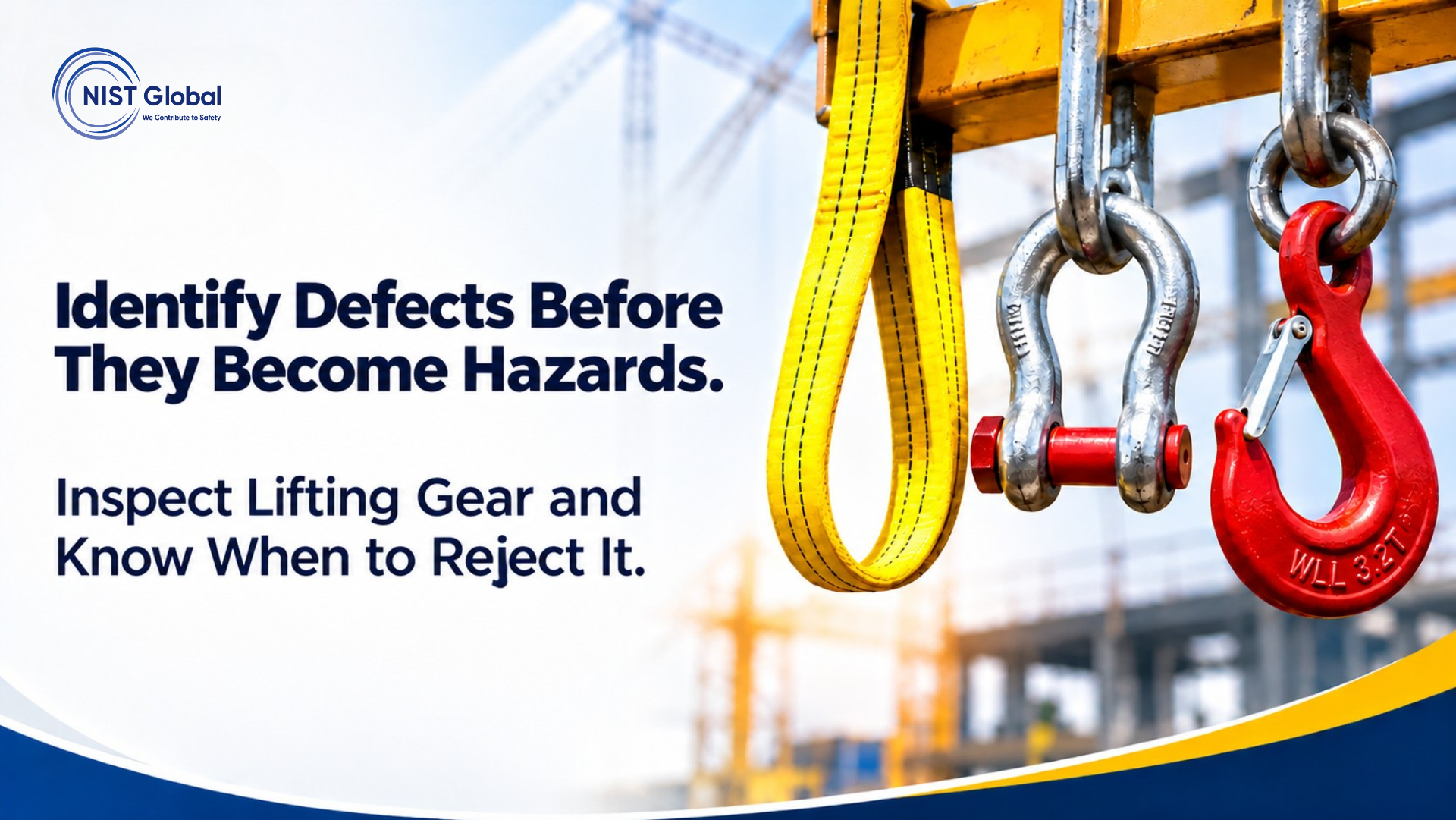
A heavy lift would depend completely on some steel links, webbing, or chains connecting the crane and the cargo together. In case of breakage of the hoist line, a bent pin in the shackle, or torn straps during a lift, the force of gravity would take control at once.
This blog explains the pre-use inspection checklist, common rejection criteria for synthetic slings, chain slings, wire rope slings, shackles and hooks, and the role of site colour coding in lifting equipment management.
What to Check Before Using Lifting Gear?
The process of lifting involves constant tugging forces, friction, and tough working conditions. Over time, metal gets elongated, synthetics get burnt or broken, and there is microscopic cracking of hardware components. By checking the gear before attaching it to the crane hook, you can make sure that:
- The rating of hardware components is suitable for the cargo: Tags and ratings are checked.
- Any wear is identified: Minor tears or burns are discovered before the gear breaks under tension.
- Only approved gear is put into use: Inspection excludes unapproved rigging tackle from work sites.
1. Synthetic Webbing and Round Sling Inspection
Polyester, nylon, and polypropylene-based artificial slings are common due to their low weight, pliability, and gentleness on smooth cargos. However, the artificial slings are sensitive to heat, rough edges, abrasive materials, and chemicals.
Hands-On Pre-Use Checklist for Synthetic Slings
Prior to employing either web sling or round sling, feel the whole length of the strap on both sides with your bare hand or gloved hand:
- Look at the label: Is it possible for you to identify the maker, serial number, and WLL (Working Load Limit)?
- Look for any lumps or bumps: Stiff or glass-like sensation of the internal fibers that have been melted indicates that the strap has gone through heat or friction.
- Look at the stitch pattern: Inspect the stitching on the eyes of the straps. Are there any missing threads?
- Look at the edges: Are there snags or cuts along the edges?
Rejection Criteria:
Synthetic slings – cuts, tears, broken stitching, chemical burns and melted fibres.
2. Alloy Steel Chain Sling Inspection
Alloy Steel Chains Grade 80 and Grade 100 are strong, resistant to heat, and perfect for the use in steel mills, foundries, and construction sites. Although alloy steel chains are designed for demanding lifting operations, overloading, wear and deformation can cause permanent elongation and compromise their strength.
Hands-On Pre-Use Checklist for Chains
Place the chain sling flat on a clean workbench, or suspend it vertically from the hook:
- Examine the metal identification tag: The metal identification tag must be secured by wire to the master link.
- Inspect each individual link: Is there any twisting, gouging, or bending? If so, then it will not be straight.
- Determine ease of link movement: Do the links operate easily against each other, or are they stiff?
- Rust and pitting: Can rust be cleaned off? Pitting results in small holes in the metal core.
Rejection Criteria:
Chain slings – cracks, deformation, excessive wear and elongation.
3. Wire Rope Sling Inspection
Wire rope slings are made up of strands which themselves are made up of wires that are twisted. Wire rope slings offer a good measure of strength and warnings before a breakage occurs by way of broken wires.
Hands-on Pre-Use Inspection of Wire Ropes
- Bend the rope to see if there are any stiff spots or if any broken wires come through as fishhooks.
- Look at the rope eyes to see if there are any cracks in the ferrules, or if the thimbles have twisted or flattened.
- Check for kinks or corkscrews and/or doglegs.
Rejection Criteria:
Wire rope slings – broken wires, kinking, bird-caging and damaged end fittings.
4. Rigging Shackle Inspection
Shackles are the standard connecting devices of the rigging trade, which connects the slings to the crane hook and cargo pad eyes. Industrial lifting operations mostly employ either Bow Shackles (Anchor Shackles) or D Shackles (Dee Shackles).
Shackles Hands-on Pre-Use Check List
- Inspection of the forged body marking: The markings on the forged body should consist of raised letters denoting WLL capacity, manufacturer’s trademark, and the size.
- Check the pin: The pin must turn freely by hand until the pin shoulder contacts the shackle body.
- Check the body form: The shackle bow should be straight and symmetrical.
Rejection Criteria:
Shackles – bent pins, body distortion, cracks and excessive wear.
5. Crane and Hoist Hook Inspection
The crane hook bears the complete weight of the hanging load. Since it comes into contact with heavy lifting equipment, it needs to be checked for open throat stretch and latching mechanism.
Hook Hands-On Pre-Use Checklist
- Check the safety latch: Press the latch open and release your hands. Should the spring close the latch securely on the hook point?
- Inspect the hook saddle: The interior of the bowl portion of the hook where the shackles lie is there any scoring or sharp indentation?
- Inspect the hook shank: Does the hook body remain straight or is it twisted to one side?
Rejection Criteria:
Hooks – cracks, throat deformation, twisting and damaged safety latches.
Rejection Criteria Summary for All Gear
Use this fast comparison table for your everyday yard inspection work:
| Lifting Gear Type | Key Inspection Points | Immediate Rejection Threshold |
|---|---|---|
| Synthetic Slings | Tags, edges, stitching, body surface. | Missing tag, cuts on edges, core exposed, knots, melted fibers. |
| Alloy Chains | Links, master links, connection pins. | Missing metal tag, stretched links, >10% link wear, heat scorch. |
| Wire Rope Slings | Outer wires, thimbles, ferrules, lay length. | 10 broken wires in one lay, kinks, bird-caging, crushed thimbles. |
| Shackles | Bow, pin threads, pin straightness. | Bent pin, modified body, elongated eye holes, >10% crown wear. |
| Hoist Hooks | Throat opening, latch, bowl saddle. | >5% throat stretch, broken latch, visible twist, cracks. |
The Process of Using Site Colour Code
For construction sites having numerous lifting devices, plant installations, and shipyards, where there are many lifting devices, it is impossible to go through each document prior to each lift. The Site Colour Code helps verify the inspection process of an equipment instantly.
The System at Work
- Thorough Testing and Inspection: Periodic inspections are conducted at intervals determined by applicable regulations, manufacturer recommendations and site inspection procedures. Equipment that passes inspection may receive a colour tag or marking corresponding to the site’s current inspection cycle.
- The Colour Tag System: The rigging hardware that passes the inspection gets colour coded in accordance with that particular period through a tough zip tie or metallic tag or a painted band on the shackle body/master link.
- Posting Charts: The chart is put up at all the entries, crane cabs, and tool cribs so that everybody knows which colour is currently being used.
- Enforcement on Site: If a rigger find a piece of equipment bearing the previous quarter’s colour tag or no colour tag at all, it is taken out of service and sent for re-certification.
Note: Do not paint the entire hardware body with colour. Also do not paint directly on the threads of shackle pins or synthetic fibers.
Gain Certified Rigging Expertise with NIST Global
Conducting visual inspections is an important aspect of workplace safety, which demands practice, understanding standards, and proper training. With NIST Global, you get practical training programs related to industry standards for industrial and infrastructure personnel in India:
- Lifting & Rigging Training: Practical training course including sling inspections, shackle and hooks assessment, proper hitching, sling angle tension multipliers, and safe loading of loads.
- Lift Supervisor Programs: Practical training on lift planning, rigging hardware refusal, exclusion zone management, and crane co-ordination at the lifting site.
- Auditing & Safety Walkthroughs for Rigging at Lifting Sites: Expert evaluations of your rigging equipment inventory, rigging hardware storage arrangements, and inspection records against OSHA and Indian Standards (IS).
Get your rigging personnel trained on how to recognize the risks at work. Learn more about certified courses offered by NIST Global Lifting & Rigging Training.
Key Takeaways
- Inspect Before Use: Check slings, chains, shackles and hooks for visible damage, wear and identification markings.
- Know Rejection Criteria: Remove equipment with cuts, cracks, broken wires, stretched links, bent pins or damaged safety latches.
- Follow Colour Coding: Verify the site’s current inspection colour code before using lifting equipment.
- Quarantine Damaged Gear: Tag and isolate defective equipment to prevent accidental reuse.
FAQs
Q1. How often should lifting equipment be inspected?
Inspect lifting gear before use and conduct periodic inspections at intervals specified by applicable standards and manufacturer recommendations.
Q2. When should a synthetic sling be rejected?
Reject slings with cuts, torn stitching, melted fibres, chemical damage or exposed core yarns.
Q3. What are the common rejection signs in chain slings?
Cracks, excessive wear, stretched links, distortion, severe corrosion and heat damage.
Q4. Why is colour coding used for lifting equipment?
It helps workers quickly identify equipment covered by the current site inspection cycle.
Q5. What should be done with damaged lifting gear?
Tag it as defective, remove it from service and isolate it until an authorised person assesses it.
Popular Safety Training Programmes
Behaviour Based Safety Training
Develop safe behaviours, strengthen safety culture, and reduce workplace incidents through proactive observation and intervention.
Fire Safety Training
Equip employees with the knowledge and practical skills to prevent fires, respond effectively, and protect people and assets.
Defensive Driving Training
Improve driver awareness, reduce road risks, and promote safer driving practices for employees operating vehicles.
The Right Safety Training Could Prevent the Next Workplace Incident
Explore our comprehensive range of workplace safety training programmes designed to reduce risks, strengthen safety culture, and improve workforce competence across all levels of your organization.