
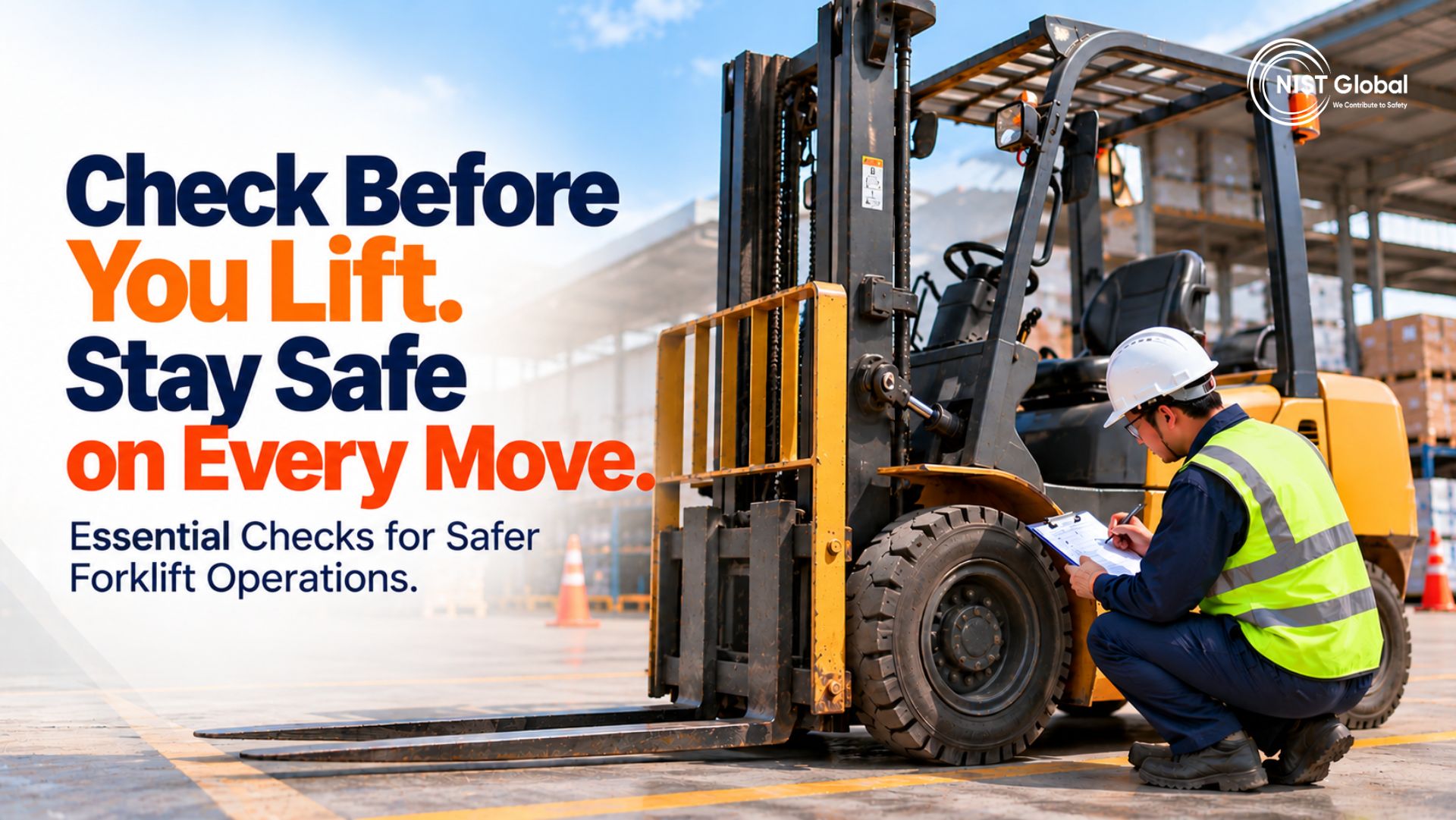
Safety in forklifts is key in ensuring that serious injuries do not occur at workplaces. It is important to note that, unlike ordinary passenger cars, multi-ton forklifts have to lift very heavy loads while navigating tight spaces. It is only through having special expertise, discipline and training that serious accidents like tip overs, rack collapse, and collisions can be avoided.
Regardless of whether you are a supervisor, safety director or an equipment operator, safe forklift operation techniques are your best form of protection. Below, the necessary guidelines for safe forklift operations ranging from the basic mechanics to load handling will be explained.
Why Forklift Safety Matters?
The forklift is an essential component of factories, distribution centers, construction sites, and other logistics centers, which lift large volumes of cargo very high up in the air and easily navigate through narrow spaces. But this strength is accompanied by great danger.
Unlike ordinary road transport, forklift trucks employ rear wheel steering. They have a high center of gravity and load that changes. In case the operator has not received adequate training, then an everyday shift can easily become very dangerous.
A good forklift safety training course provides companies with the following benefits:
- Saves Lives and Prevents Injuries: Helps avoid limb crushing, struck-by accidents, and fatalities from tipping over.
- Remains Legal: Complies with tough regulations of OSHA, IS codes, and regional safety requirements.
- Reduces Costs: Saves on maintenance expenses due to rough use, collisions, and neglected machine problems.
- Prevents Property Damage: Prevents damage to building pillars, racking, concrete floors, and valuable stock.
- Increases Efficiency: Qualified operators move loads more quickly, safely, and efficiently.
Operator’s Daily Pre-Use Checklist
Would you ever climb aboard an aircraft without a pre-flight inspection? Well, OSHA, together with other international safety regulations, requires every forklift to be inspected before every single shift. In case of more than one operator using the same forklift in different shifts, then every operator needs to perform his own pre-use inspection.
Here’s an example of an operator’s daily pre-checklist you can use for your organization.
What to Do If You Find a Defect
IMPORTANT SAFETY REGULATION: In case you notice any mechanical defect, safety hazard, or leakage of any fluid during the pre-operation inspection, you should not operate the forklift. The forklift should be immediately switched off, key removed, and a “OUT OF SERVICE” label put on the forklift.
Mastering Load Capacity and Equipment Stability
What causes skilled operators to lose control and turn over tons of metal? It all boils down to one basic physical fact. Almost everyone thinks that driving a forklift is just like driving a regular passenger vehicle, which is usually deadly thinking. While it is true that an ordinary vehicle will have a four-point suspension and low center of gravity, a forklift operates very differently by using rear-wheel steering, has tons of weight on a small mast and behaves as if it were a teeter-totter. When turning, braking or moving loads, just a little off balance, will tip the vehicle.
Fulcrum and Seesaw Mechanics
The forklift balances itself like a seesaw on the playground. The front wheels are the center fulcrum while the heavy weight of the load balances the engine and cast-iron rear section (the counterweight).
What To Do:
- Inspect the load weight: Make sure that your payload does not surpass the maximum weight stated on the capacity plate of your machine.
- Do not place additional weight on the forks: Overloading the front part of your forklift will cause the rear wheels to rise up from the floor, resulting in the loss of steering capability and tipping forward.
- Always keep the load balanced: Position all loads as close to the front wheels as possible..
Understanding the Load Capacity Data Plate
All certified forklifts have an engine data plate (capacity plate). It serves as the operating limit card of the machine.
It specifies the following:
- Lift Max Weight: The total allowable weight of what the machine can lift.
- Load Center Rating: The measurement from the vertical face of the forks to the center of gravity of the load (usually 24 inches or 600 mm).
- Max Lift Height: The height at which a certain weight can be lifted.
- Attachment Deductions: Decreases in lift capacities when utilizing special clamps, booms, and rotators.
When you load a load that moves the load center from 24 inches to 36 inches, your lift capacity becomes very low. The machine can no longer lift the maximum allowed weight.
Forklift Stability Triangle
While a car utilizes a wide four-point suspension, a forklift is mounted on a three-point suspension system.
This suspension includes the two front drive wheels and the pivot point of the rear steering axle. These three points create what is called the Stability Triangle.
The stability of the forklift is maintained if the Combined Center of Gravity of the machine and load does not go beyond the limits of the stability triangle.
What Can Cause the Center of Gravity to Move Beyond the Triangle?
- Raising Loads Excessively When Moving: Lifting the load raises the center of gravity and results in very low lateral stability.
- Making Rapid Turns at a High Speed: The centripetal force will push the center of gravity beyond the line of the drive wheels.
- Brake Suddenly or Make a Rapid Acceleration: Sudden brake action moves the center of gravity beyond the front axle fulcrum.
- Incline Movement in the Incorrect Way: Driving the forklift up and down slopes incorrectly or moving the loaded forklift across ramps.
5 Common Forklift Accidents and Prevention Strategies
As evidenced by safety statistics, over 70 percent of forklift accidents can be prevented through proper operational procedures and forklift training. Below is a list of the five most common accidents and their prevention strategies.
1. Tip-overs and rollovers
A majority of fatal forklift accidents result from tip-overs, which occur because of fast turns, loads carried high in the air, and rough floor surfaces.
Prevention Methods:
- Do not overload the forklift past its rated capacity.
- Drive with loads as close to the floor as possible—about 4 to 6 inches—masts should be tilted back a little.
- Reduce your speed before turning.
- Load the forklift and drive it upward along ramps. Move the forklift backward while driving down the ramp.
2. Pedestrian Accidents
Large facilities force pedestrians and heavy equipment like forklifts to occupy the same small aisles, where pedestrians get badly hurt if struck by the moving forklift.
Prevention Methods:
- Have painted pedestrian-only lanes on the floor surface.
- Blow a horn when approaching a blind corner, intersection, and doorway.
- Fit your forklift with blue safety spotlights and red perimeter lights.
- Establish eye contact with a pedestrian before moving close to them.
3. Loads that Fall Off and Dropped Materials
Stacked boxes improperly or damaged wooden pallets can fall from forks. There is a danger to people working underneath falling materials.
Preventative Measures:
- Check if there are cracks in deck boards and stringers of the pallets before loading.
- Secure loose, tall, or unbalanced loads with plastic stretch wrap or straps.
- Forks must be placed under the load evenly.
- Do not allow anybody to stand or walk underneath elevated forks in any case.
4. Blind Spots and Poor Visibility
Bulky, tall loads obstruct the operator’s field of view while being carried. High speed crashes happen due to driving blind into traffic areas.
Preventative Measures:
- If a tall load obstructs your visibility ahead, then you should move backward.
- Use spotters when moving in a confined area.
- Place convex mirrors at warehouse aisle intersections to see other traffic.
5. Falls from Height and Unsafe Lifts
Workers sometimes use unapproved forklift forks as makeshift ladders to reach elevated racking. Standing directly on wooden pallets or naked forks leads to fatal falls.
Preventive Measures:
- Do not transport individuals through normal forks or pallets.
- Employ fully tested, safety enclosures personnel work platforms that lock onto the carriage.
- Make sure personnel use proper full-body harnesses attached to proper tie-off points.
4 Safe Driving and Material Handling Practices
For efficient operation of your site, operators have to maintain good daily driving practices. Learn these valuable tips for your own safety and environment’s safety.
| Operational Phase | Safe Operating Rule | Danger Being Prevented |
|---|---|---|
| Speed Control | Maintain a controlled safe speed | Prevent tip-overs, skidding, and collision impact forces. |
| Ramp Travel | Keep loads pointed uphill whether ascending or descending. | Prevent loads from sliding off forks and machine tipping. |
| Aisle Clearance | Keep arms, hands, legs, and feet inside the cab frame at all times. | Prevent crushing limbs against steel storage racks. |
| Parking Safety | Lower forks flat to ground, set parking brake, turn off power, remove key. | Prevent unintended rolling or trip hazards from elevated forks. |
Importance of Certified Forklift Training
Acquiring proficiency in forklift driving is an empowering process towards creating a safe working environment. Forklift training provides operators with all the skills required by combining classroom knowledge with actual driving experience. By doing so, the operators acquire all the necessary competencies to ensure smooth operations and enhance safety for all individuals at the workplace.
What Makes a Good Training Program?
Excellent safety training always uses a standard learning process that includes:
- Theoretical Education: Emphasizes various types of machinery, principles of physics, center of gravity, weight limits, potential hazards, and regulations.
- Hands-On Driver Training: Trainees are trained under close guidance of instructors in checking the forklifts, turning aisles, climbing ramps, and stacking items on high racks.
- Workplace Evaluation: Instructors assess the trainees while working on their sites using actual forklifts.
When Should Refresher Training Be Done?
Certified training is not something that you do only once. It has to be done again after three years, or even before that in the following instances:
- Operator is involved in any type of accident.
- Operator is seen dangerously operating the forklift.
- New forklifts or attachment mechanisms are used at your facility.
- There are new hazardous zones in the workplace owing to the changed layout.
Elevate Your Facility’s Safety Standards
Going zero accident does not just seem utopian but something that can actually be accomplished everyday. Your workplace culture should emphasize the importance of pre-use inspection, accurate load calculation, and regular operator training to ensure they operate at maximum speed and efficiency with utmost confidence. Safety will not hold back production; safety will drive production sustainability.
If you wish to change the safety regulations into an everyday routine, get in touch with NIST Global. As one of the top corporate safety companies, NIST Global offers forklift safety training courses from professional trainers to suit all the requirements of your workplace.
On-Site Forklift Safety Training for Your Workforce
NIST Global provides on-site forklift safety training for organizations across India, combining classroom/theoretical instruction, practical training and workplace evaluation based on applicable requirements and site conditions.
Key Takeaways:
Training for Forklift Safety Is Crucial: It is crucial to have trained forklift operators to avoid any serious injury or structural damage to your facility.
- Inspect Your Equipment: Do a comprehensive visual and operational inspection before driving to identify any problems with your forklift.
- Load Capacity Regulations Must Be Adhered To: Maintain the center of gravity within the stability triangle to avoid any dangerous overturning.
- Know About the Major Hazards: Most of the accidents happen due to overloading, speeding, lack of visibility, and pedestrian strike.
- Education Is Key to Safety Compliance: Regular refresher courses are vital for staying compliant with OSHA and IS codes.
FAQs
1. How frequently must a forklift pre-use inspection be carried out?
Pre-use inspection needs to be done before each shift begins. In case the forklift is operated on many shifts in a row, a new inspection has to be performed by each shift’s operator before operation.
2. What should an operator do during a tip-over accident?
If you operate a sit-down forklift, remain inside the cabin. Don’t try to leave the cabin because most deaths happen when operators are hit by the overhead guard while attempting to jump. Hold the steering wheel firmly, put feet on the floorboards, and lean away from the tipping direction. For stand-up forklifts with rear entrance, leave the cabin fast.
3. What is the load center of most industrial forklifts?
The standard industrial forklift load center is 24 inches (600 mm) from the face of the forks vertically to the load’s center of gravity. Using long or oddly shaped loads will increase the forward distance of the center of gravity.
4. How often must a forklift operator be evaluated?
Under OSHA requirements, powered industrial truck operators must be evaluated at least once every three years. Additional refresher training may be required following certain incidents, unsafe operation, changes in workplace conditions, or the use of different truck types.
5. Is it possible to operate a forklift for small tasks without certification?
No. Under OSHA and international regulations, it is strictly prohibited to let anyone who is not certified operate forklifts in any case. Only trained operators who have received classroom and practical training can operate forklifts.
6. What is a forklift checklist?
A forklift check list is a standard daily check list used by the forklift operator to ensure that the forklift is safe and mechanically sound prior to operating the forklift.
This mandatory task according to safety guidelines such as OSHA is made up of two parts:
- Visual Check (Engine OFF): Looking for fluid leaks, broken tires, cracks in the fork heels, deteriorated hydraulic hoses, readable data plates, and operable seat belts.
- Functional Check (Engine ON): Ensuring that the service brakes work, responsive steering, sufficient volume of the horn, backup alarm system, and operable hydraulic lift/tilt system.
Should any defect be found, the forklift is tagged out (“OUT OF SERVICE”).
7. What is the load capacity on a forklift?
The lift capacity of a forklift truck is the maximum amount of load that it can lift and carry at a certain load center distance.
Points to remember regarding lift capacity:
- Data Plate Specified: This data is found in a metal specification plate on the forklift cab. This includes maximum capacity, maximum lift height, and any attachments that can reduce lift capacity.
- The Load Center Effect: In case a load is long or unbalanced and the center of the load moves more than 24 inches from the face of the forks, then the lift capacity becomes greatly reduced.
- Overload Effects: If this capacity is exceeded, then the rear wheels will be lifted off the floor.
8. What is the capacity of a 5 ton forklift?
Forklift with the capacity of 5 tons will have the capacity of 5,000 kilos (11,023 pounds or 5 metric tonnes) with a standard load center of 24 inches or 600 millimeters.
Critical facts:
- Standard Reach: The forklift is capable of handling 5,000 kg load provided that its center of gravity lies within 24 inches of the fork carriage.
- Height Reach: While lifting the load to its maximum height, there will be a slight reduction in the rated capacity of the load as given in the data plate.
- Load Attachments: There will be additional load due to the attachment used, and the load center will shift forward.
Popular Safety Training Programmes
Behaviour Based Safety Training
Develop safe behaviours, strengthen safety culture, and reduce workplace incidents through proactive observation and intervention.
Fire Safety Training
Equip employees with the knowledge and practical skills to prevent fires, respond effectively, and protect people and assets.
Defensive Driving Training
Improve driver awareness, reduce road risks, and promote safer driving practices for employees operating vehicles.
The Right Safety Training Could Prevent the Next Workplace Incident
Explore our comprehensive range of workplace safety training programmes designed to reduce risks, strengthen safety culture, and improve workforce competence across all levels of your organization.