
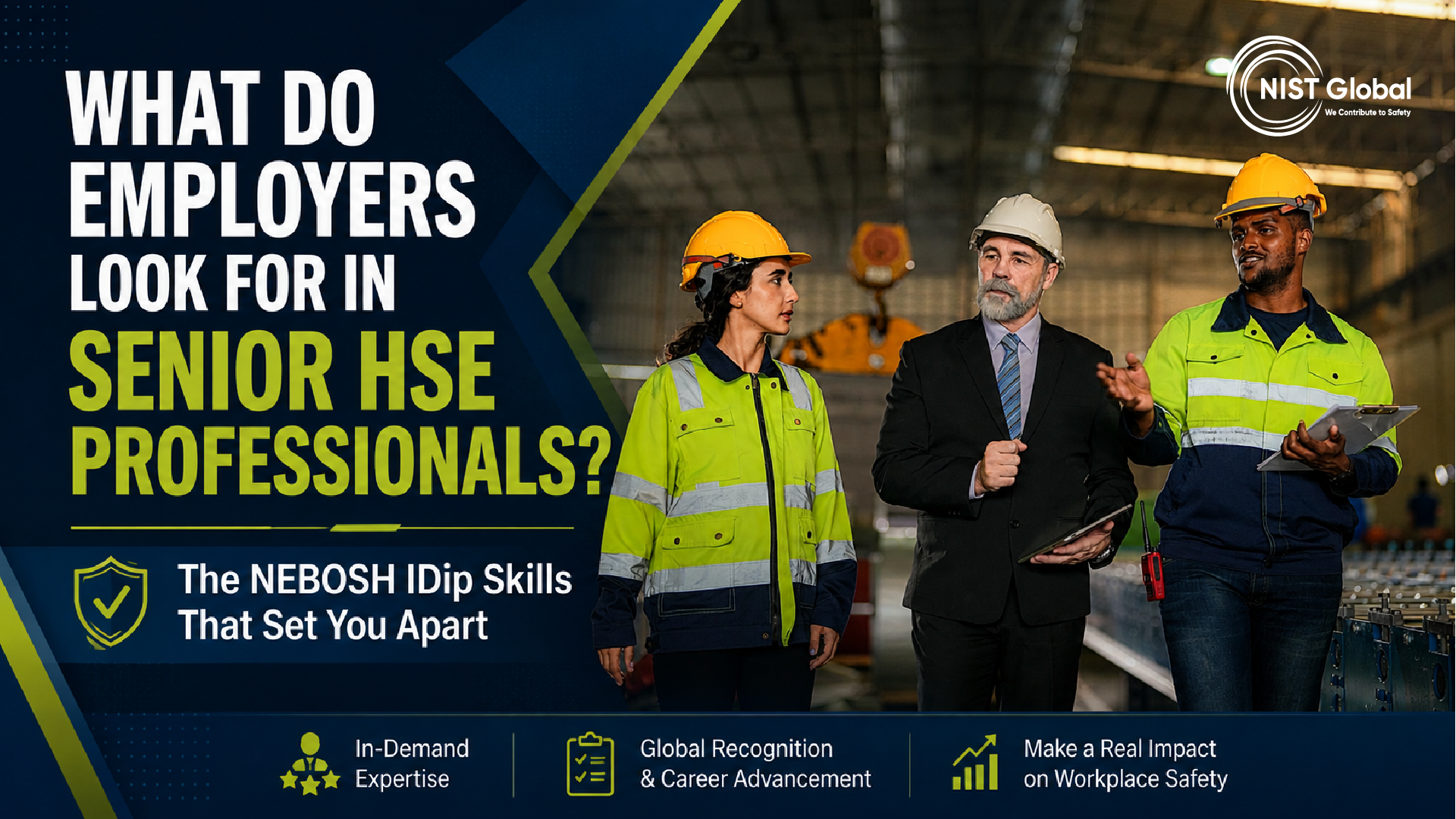
A senior HSE professional is expected to do much more than identify hazards and check whether workers are wearing PPE.
With the growth in complexity of organisations, employers are increasingly requiring safety professionals that can have a greater impact on leadership decision making, conducting investigations, increasing safety performance, and embedding health and safety as a business function.
The NEBOSH Level 6 International Diploma for Occupational Health and Safety Management Professionals (NEBOSH IDip) can make a difference here.
This qualification aims to build knowledge and skills to work as a first-class health and safety professional. It includes a range of topics, including risk management, safety culture, health and safety management systems, competence, contractor management and workplace controls.
However, what are the skills that employers are interested in when selecting candidates for senior HSE positions and promoting employees?
These are some of the most important skill sets that can distinguish a Diploma-level HSE expert.
1. Strategic Risk Management
Senior HSE practitioners should pay attention to the big picture of risks in the organisation, rather than just specific hazards.
Employers want professionals who can:
-
Identify significant workplace risks
-
Evaluate the likelihood and potential consequences of those risks
-
Recommend proportionate control measures
-
Prioritise actions based on risk
-
Monitor whether controls are actually effective
-
Contribute to organisational risk-management strategies
For instance, the first element of an unsafe lifting operation is to recognise it. A senior HSE professional should also be able to comprehend the reason for the risk, understand the effectiveness of current control measures and be able to suggest changes that are realistic for the business.
The NEBOSH IDip enables professionals to learn to work in a different way when managing risk, one that is not simply a checklist operation.
2. Safety Leadership and Influencing Skills
Being a technical professional isn’t enough to make someone a good HSE leader.
Senior professionals may need to influence individuals who are not direct reports such as:
-
Operations managers
-
Project managers
-
Engineers
-
Contractors
-
Supervisors
-
Senior executives
-
Workers and employee representatives
This will involve excellent communication, influencing and leadership skills.
A safety recommendation may be technically correct, but if an HSE professional cannot explain why the change is necessary, what risk it addresses and how it supports the organisation, implementation can become difficult.
NEBOSH has emphasised the importance of leadership and practical application in its Diploma qualifications. The current International Diploma is also designed to help professionals promote a positive health and safety culture and develop health and safety strategies.
3. Incident Investigation and Root-Cause Analysis
When an incident occurs, employers need more than someone who can document what happened.
A senior HSE professional should be capable of determining:
-
What happened?
-
Why did it happen?
-
Which controls failed?
-
What underlying factors contributed to the event?
-
What needs to change to prevent recurrence?
Effective incident investigation looks beyond the immediate unsafe act or condition.
For example, when a worker is injured due the removal of an equipment guard, the assumption that it was the worker’s fault may mask a deeper problem like inadequate maintenance, production pressure, poor supervision, defective equipment or ineffective management controls.
It is therefore a valuable skill for senior HSE roles to be able to systematically probe incidents and find meaningful corrective action.
4. Health and Safety Management Systems
Employers increasingly expect HSE professionals to understand how individual safety activities fit into a broader management system.
A senior professional may be involved in:
-
Developing HSE policies
-
Setting objectives and targets
-
Conducting audits
-
Monitoring performance
-
Reviewing compliance
-
Managing corrective actions
-
Evaluating management-system effectiveness
-
Supporting continual improvement
The NEBOSH Level 6 International Diploma has a dedicated module on developing and auditing health and safety management systems as one of its intended professional skills.
This helps to shift the HSE function from being reactive towards problem solving to structured and continuous improvement.
5. Ability to Interpret Safety Data
Modern HSE departments generate significant amounts of information.
Incident reports, near miss records, audit findings, inspection observations, training records and leading indicators may all provide an insight into safety performance.
However, collecting data is not enough.
Employers need HSE professionals who can interpret the information and identify what it means for the organisation.
For example, a rise in near-miss reports may initially appear negative. But if the increase results from employees becoming more willing to report unsafe conditions, it could indicate an improvement in reporting culture.
A senior HSE professional needs to ask the right questions before drawing conclusions from safety data.
6. Strong Communication and Reporting
Senior HSE professionals frequently communicate with different audiences.
A site supervisor may need a practical explanation of a control measure, while senior management may need a concise overview of risk exposure, compliance status and business impact.
Therefore, an effective HSE professional should be able to communicate technical information clearly without unnecessarily complicating it.
This includes:
-
Writing clear investigation reports
-
Presenting audit findings
-
Preparing management reports
-
Conducting toolbox talks and briefings
-
Explaining risks to non-technical stakeholders
-
Making evidence-based recommendations
Good communication can turn safety information into safety action.
7. Understanding of Legal and Regulatory Requirements
Senior HSE professionals need to understand the legal and regulatory environment relevant to their operations.
This does not simply mean memorising legislation.
They need to determine:
-
Which requirements apply to the organisation
-
How those requirements affect operations
-
Where compliance gaps exist
-
What action is required
-
What the potential consequences of non-compliance could be
The NEBOSH International Diploma includes the ability to advise on applicable legislation, relevant guidance and possible enforcement actions among its intended learning outcomes.
This knowledge becomes particularly valuable for professionals working across different industries, locations and regulatory environments.
8. Contractor and Supply-Chain Management
Contractors can introduce significant risks into workplaces, particularly in sectors such as construction, manufacturing, oil and gas, infrastructure and facilities management.
Senior HSE professionals may therefore be expected to contribute to contractor-selection processes, prequalification, induction, competency verification, monitoring and performance evaluation.
Effective contractor management requires more than checking whether documentation has been submitted.
The HSE professional needs to understand whether contractors actually have the competence, resources, systems and controls required to perform the work safely.
NEBOSH identifies contractor and supply-chain compliance as one of the areas covered by the current International Diploma.
9. Building a Positive Safety Culture
Safety culture is reflected in how people behave and make decisions when nobody is watching.
Senior HSE professionals play an important role in shaping that culture.
They may need to identify issues such as:
-
Employees normalising unsafe practices
-
Supervisors prioritising productivity over safety
-
Poor near-miss reporting
-
Inadequate management visibility
-
Weak accountability
-
Resistance to safety improvements
The objective should not simply be to increase the number of rules.
It should be to create an environment where people understand risks, report concerns, participate in safety activities and believe that management genuinely values their wellbeing.
The NEBOSH International Diploma includes promoting a positive health and safety culture as one of the capabilities developed through the qualification.
10. Turning Safety Recommendations into Business Improvements
Perhaps one of the most important skills for a senior HSE professional is the ability to connect safety with business performance.
A safety improvement can influence:
-
Productivity
-
Operational continuity
-
Asset protection
-
Employee wellbeing
-
Compliance
-
Reputation
-
Cost of incidents
-
Business resilience
For example, improving preventive maintenance may reduce both equipment-related incidents and unplanned downtime.
This is why senior HSE professionals increasingly need to communicate safety recommendations in terms that business leaders understand.
Instead of simply saying:
“This control is required for safety.”
A stronger recommendation may explain:
“Implementing this control can reduce exposure to the identified risk while supporting operational reliability and compliance.”
That shift from safety activity to business value is an important characteristic of strategic HSE leadership.
NEBOSH IDip: From Knowledge to Professional Capability
The value of the NEBOSH IDip is not simply the qualification certificate.
Its purpose is to develop the knowledge and practical capability required to address real workplace health and safety challenges.
The current NEBOSH Level 6 International Diploma was developed with input from hundreds of stakeholders, including employers, previous Diploma learners, Learning Partners and subject experts. NEBOSH states that the qualification is intended to provide the knowledge and practical skills needed to perform as a leading health and safety professional.
For professionals aiming for senior HSE responsibilities, this distinction is important.
Employers are not simply looking for someone who knows safety terminology.
They are looking for professionals who can:
Identify → Analyse → Advise → Influence → Implement → Measure → Improve
That is the difference between knowing about health and safety and being able to lead health and safety performance.
How NIST Global Supports Your NEBOSH IDip Journey
Choosing the right learning partner can be an important part of preparing for the NEBOSH International Diploma.
NIST Global is India’s first NEBOSH Gold Learning Partner and offers the NEBOSH Level 6 International Diploma through flexible learning options, including virtual, face-to-face and e-learning formats. Its programme includes structured learning resources, tutor guidance and practical industry insights.
With its focus on practical HSE expertise, NIST Global helps professionals connect Diploma-level concepts with the challenges they may encounter in real workplace environments.
Whether your goal is to progress into a Senior HSE Manager, HSE Lead, Safety Manager, HSE Consultant or another strategic safety role, developing the right professional capabilities is essential.
Final Thoughts
The expectations placed on HSE professionals are changing.
Senior safety roles increasingly require professionals who can combine technical knowledge, risk management, leadership, communication, data interpretation and business understanding.
A NEBOSH IDip can provide a strong foundation for developing these capabilities and progressing towards higher-level HSE responsibilities.
Ultimately, the most valuable outcome is not simply adding “IDipNEBOSH” to your professional credentials.
It is developing the confidence and competence to make better safety decisions, influence people, manage risk and contribute to meaningful improvement across an organisation.
Ready to take the next step in your HSE career? Explore the NEBOSH Level 6 International Diploma with NIST Global and build the skills needed for the next stage of your professional journey.
Popular NEBOSH Courses
NEBOSH International General Certificate (IGC)
For beginners and supervisors wanting a strong foundation in health & safety.
NEBOSH International Diploma (IDip)
For experienced safety professionals aiming for senior HSE roles.
NEBOSH Process Safety Management (PSM)
For those in high-hazard industries focusing on process safety management.