
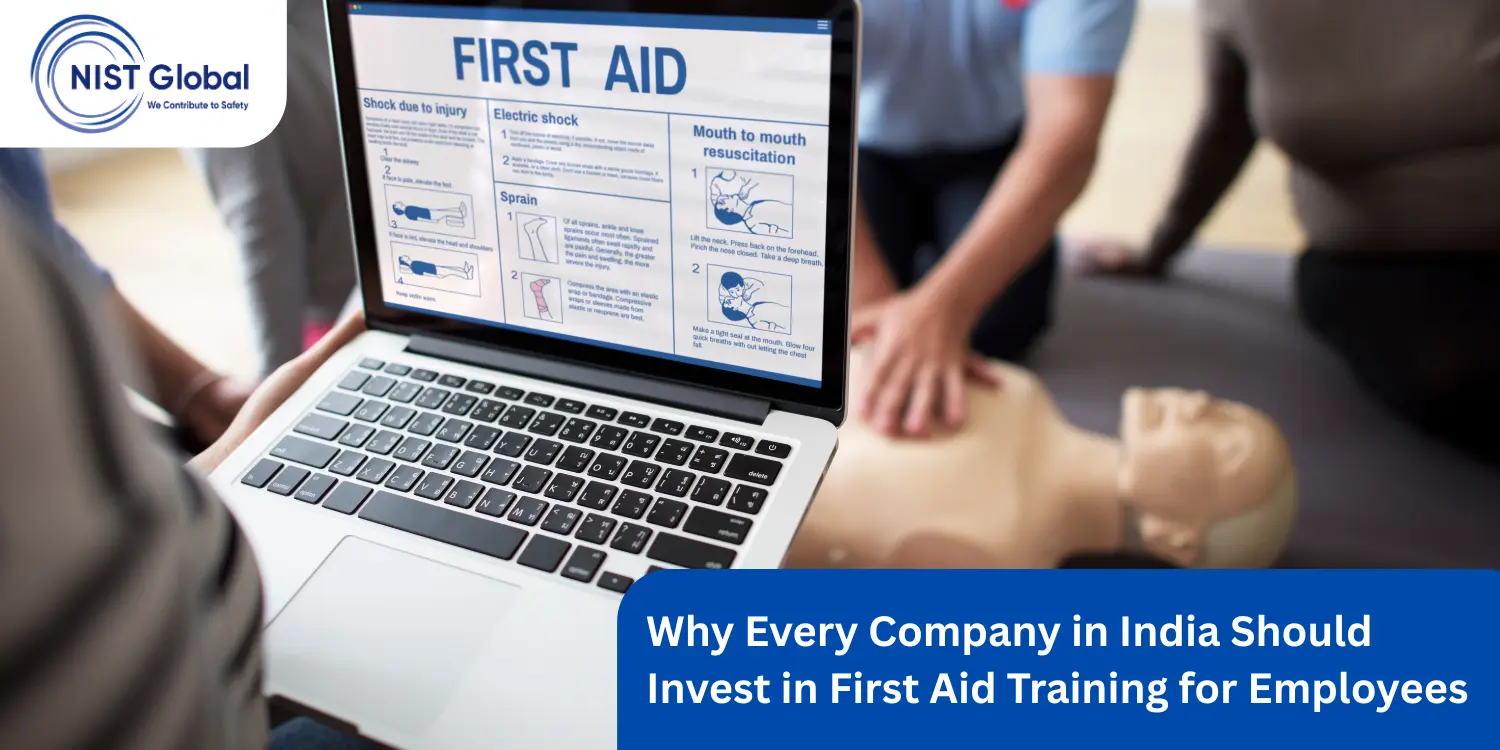
Why Every Company in India Should Invest in First Aid Training for Employees
First aid training for employees in India prepares your workforce to deal with emergency first aid situations. It is aimed to train the bystanders in providing professional medical assistance to preserve life and prevent the victim’s condition from worsening further.
Around 98% of India’s population lacks a basic awareness of first aid training. This dearth of awareness makes the 500 million workforce vulnerable during the ‘Golden Hour.’ For a Plant Manager or an Operational Head, this is not just another health statistic. It is a critical operational risk. In the event of a cardiac arrest or a high-impact machinery injury, the time before professional help arrives is not just critical for the victim’s survival but also for the legal and reputational standing of the organisation.
What do the regulations say?
Section 45 of the Factories Act (1948) is a safety compliance act in India. This act mandates that every registered Indian factory should have first aid appliances. Further, there should be at least one qualified personnel for every 150 employees. Failure to comply with these statutory requirements does not just increase the compliance pressure. It also makes the organisation legally vulnerable during fatal accidents.
Several Indian firms fail when they just restrict the definition and compliance of first aid to ‘paperwork.’ It shouldn’t be mistaken as it is a competency that your organisation builds in. The Directorate General Factory Advice Service and Labour Institutes (DGFASLI) emphasises that basic first aid knowledge is important to manage workplace emergencies. To list a few of these emergencies are – chemical burns, electric shocks, and heat strokes, which are quite prevalent across Indian industries.
How To Bridge the Safety Awareness Gap?
Indian organisations have their own unique challenges, particularly when it comes to their contract labour workforce. Temporary workers often deal with lower levels of safety awareness. They are the ones who receive inadequate training compared to their permanent staff. As a result, a fragmented safety culture is quite evident, where the majority of the individuals on the shop floor are least ready to handle the crisis.
A common list of challenges includes:
- Lack of Muscle Memory: Theoretical training is worthy, but they often fail the depth to train the workers with practical skills. This simulated learning approach is crucial in the event of a high-stress health crisis.
- Perishable Skills: First aid skills are like your perishable food stuff. Your workforce needs to preserve the knowledge gained. Regular refresher courses play a key role in brushing up their knowledge so that your workforce acts confidently.
- Poor Safety Culture: Do not just ignore your safety compliance as a checklist point. It should permeate the day-to-day behaviour of every employee in your organisation.
How Does Workplace First Aid Training Benefit Your Organisation?
An investment in a robust workplace first aid training offers tangible benefits to the organisation:
- Reduced Workplace Incidents
- Stronger Safety Culture
- Optimised Recovery
- Improved Compliance
- Mitigation of Legal and Financial Liabilities
- Enhanced Crisis Response
- Boosted Employer Brand and Talent Retention
- Improved Behavioural Safety Awareness
- Reduced Stress on In-house Medical Facilities
- Streamlined Emergency Communication
- Preparation for Non-workplace Emergencies
Indian Industry-Specific Scenarios
A generic training would rarely shield your organisation. Tailored training makes your organisation capable of handling specific industrial risks.
- Manufacturing and Logistics: Workers are exposed to heavy machinery and sharp objects. Training in wound management and bleeding control is essential.
- Construction: Falls from height are common. Fracture immobilisation and spine injury management training are critical.
- Oil & Gas and Chemicals: Chemical and thermal hazards require training on burn care and managing chemical exposure.
- Mining & Quarrying: Remote locations demand training in injury management and respiratory distress due to dust inhalation.
- E-commerce & Warehousing: Risks include musculoskeletal injuries and concussions. Training on lifting techniques and concussion protocols is important.
The Role of Comprehensive Training Programmes
A professional instructor-led programme ensures both theoretical understanding and practical skill development to build ‘muscle memory.’
- High-Quality CPR: Maintaining a chest compression rate of 100–120 per minute along with rescue breathing.
- AED Training: Learning to use Automated External Defibrillators within the critical “Golden Hour.”
- Scenario-Based Learning: Simulations that mimic real workplace emergencies.
- Primary and Secondary Survey: DRSABCD protocol for systematic emergency response.
- Choking and Airway Management: Heimlich manoeuvre and airway clearance techniques.
- Environmental Emergency Management: Handling heat stroke, dehydration, and snake bites.
- Burn and Chemical Care: Proper procedures for managing burns and chemical exposure.
Actionable Strategy
Rather than treating the first aid training for employees in India under a “one-size-fits-all” approach, Safety and Plant Managers should consider implementing this practical framework:
- Hazard Mapping: A site-specific audit is required to identify the primary risks associated with chemicals, electrical, and mechanical hazards.
- Strategic Placement: The training ensures first aiders are distributed across all shifts, specifically targeting zones with high contract labour density.
- Simulation-Based Assessment: Replacing the static PowerPoint presentations with realistic scenarios is crucial to mimic the heat, noise, and pressure at the Indian workplaces. It helps to build your workforce’s muscle memory.
- Tiered Competency Training: A tiered competency training ensures proper delegation of the training. For e.g. a basic skill training such as wound care is essential for the entire workforce, while advanced certification such as AED (Automated External Defibrillator) usage is important for a core emergency response team.
- Resource Accessibility Audit: A resource accessibility audit ensures the availability of first aid appliances as mandated by Section 45 of the Factories Act (1948). These are present across high-risk zones and not stored just within the administrative offices.
- Multilingual Instructions: Training is delivered in regional languages so that the contractual labour workforce doesn’t feel left out. It is crucial for them to understand the safety protocols fully.
Conclusion
First aid training for employees in India is no longer just a checkbox activity for the Plant and Safety Managers. It is a strategic organisational investment to ensure that it cares for its people’s safety. Empowering employees with the essential skills transforms a culture of passive bystanders into a proactive and resilient respondent.
Take the first step toward a safer workplace with NIST Global’s instructor-led, globally recognised, and industry-specific first aid training today.
Key Takeaways
- First aid training for employees in India is a mandate under Section 45 of the Factories Act (1948).
- A proactive training is your organisation’s shield to reduce workplace incidents, improve safety compliance, and establish a stronger safety culture.
- Approximately 98% of the Indian population lacks a basic understanding of a first aid response.
- NIST Global’s first aid training is tailored to high-risk sectors such as manufacturing and construction.
FAQs
1. Why is First Aid, CPR & AED training mandatory for Indian organisations?
It is mandated under Section 45 of the Factories Act (1948), which requires factories to provide first aid facilities and trained personnel.
2. How many trained first-aiders are required?
At least one trained personnel for every 150 employees must be available during working hours.
3. What are common workplace injuries in manufacturing?
Injuries typically include cuts, fractures, and machinery-related accidents.
4. Can first aid training reduce man-days lost?
Yes. Immediate care such as fracture immobilisation or burn treatment significantly reduces recovery time and lost workdays.
Popular Safety Training Programmes
Behaviour Based Safety Training
Develop safe behaviours, strengthen safety culture, and reduce workplace incidents through proactive observation and intervention.
Fire Safety Training
Equip employees with the knowledge and practical skills to prevent fires, respond effectively, and protect people and assets.
Defensive Driving Training
Improve driver awareness, reduce road risks, and promote safer driving practices for employees operating vehicles.
The Right Safety Training Could Prevent the Next Workplace Incident
Explore our comprehensive range of workplace safety training programmes designed to reduce risks, strengthen safety culture, and improve workforce competence across all levels of your organization.