
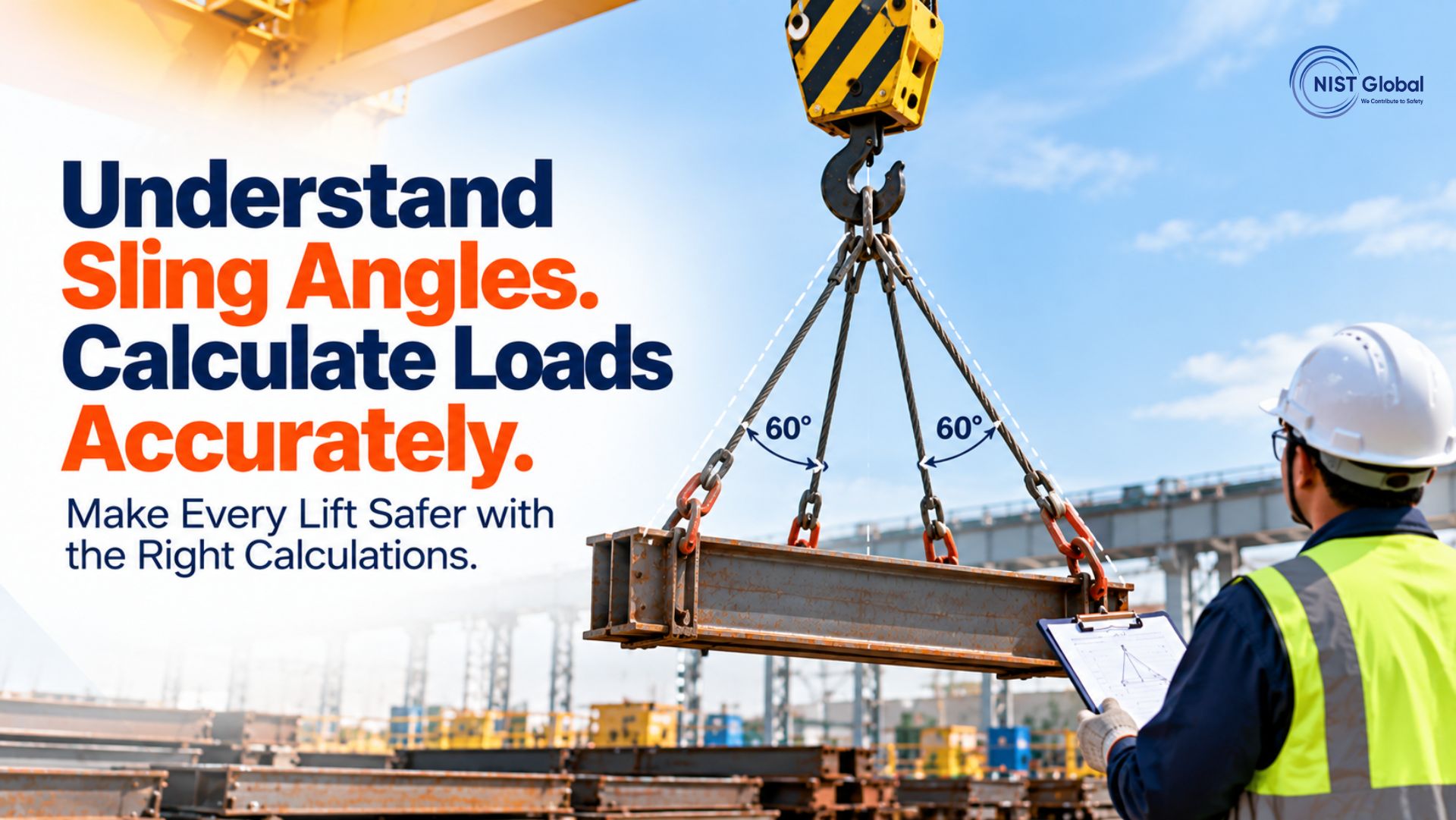
Safety of sling angles boils down to a field guideline, which states that the wider your slings spread, the more secret weight you have to lift with your equipment. So even with a 3-ton load, if you lift it using a horizontal sling angle, your straps will easily be subjected to 6 tons of pull.
This blog explains how sling angles affect load distribution, how to identify unsafe rigging configurations, and the methods to check sling capacities before lifting a load.
The Golden Rule of Sling Angles: Flatter Means Heavier
If slings are hanging vertically, they only have the capacity of holding the cargo’s weight. However, once the slings are angled towards one another, there will be two forces acting on them – they pull upwards in an attempt to lift the cargo while they push one another.
The greater the angle between a sling and cargo, the greater the force acting between the slings will be. This, in turn, results in extremely high tension within your equipment.
The Visual Angle Cheat Sheet
Memorize these four standard field angles before hooking up your next pick:
| Sling Angle from Load | What Happens to the Force? | The Rule of Thumb | Field Verdict |
|---|---|---|---|
| 90° (Straight Up) | Normal load (1.0x) | Direct vertical lift; true load weight. | Ideal |
| 60° (Equilateral Triangle) | 15% Extra Pull (1.15x) | Distance between pick points roughly matches sling length. | Best Everyday Angle |
| 45° (Standard Spread) | 40% Extra Pull (1.41x) | Vertical clearance is lower; straps feel noticeably heavier. | Safe & Common |
| 30° (Flat & Wide) | Double the Weight (2.0x) | Slings are wide; each leg holds the weight of the entire load! | Absolute Minimum |
| Below 30° | 4x Weight or More (3.8x+) | Extreme inward force; high risk of hardware failure and crushed boxes. | STOP THE LIFT |
Hard Safety Rule: Industrial safety rules (e.g., OSHA, ASME) do not allow the lift at less than 30 degrees without being engineered and stamped by the engineer. If your slings appear to be less than 30 degrees incline, go for longer slings or spreader bar.
Two Simple Lift Checks Before You Rig
Keep things simple with two required pre-lift tests:
1. Determine the Gross Weight (Weight of Cargo plus Rigging)
- New lifters will usually check out the shipping document or machine plate. To be safe when calculating capacity, include:
- The weight of the cargo itself
- Any lifting beams or spreader bars you use
- Shackles, hooks, chains, and straps used for rigging
2. Find the Heavy End (Center of Gravity)
- Loads that have symmetrical weight distribution (steel pipes, normal crates) distribute their weight evenly among your slings.
- Loads with asymmetrical weight distribution (machinery skids with off-center motor or pump) will place far more load on the nearest sling leg.
Plain-English Field Scenarios
Scenario 1: Balance, 6-Ton Pipe at 60°
- You are lifting a 6,000 kg pipe with a 2-leg chain sling at an angle of 60° safely:
- The weight to be divided equally into 2 legs is 3,000 kg per leg.
- With 60° tilt, the weight carried by each leg will be around 15% higher (3,000kg x 1.155=3,465kg).
- The Pick: Do not use 3-ton slings. You need to use slings and shackles that are marked with a minimum rating of 3.5 tons (3,500 kg).
Scenario 2: An Off-Center 8-Ton Skid
You are rigging a 8,000kg compressor skid with a heavy pump located immediately adjacent to Sling A:
- Sling A is carrying 75% of the total load (6,000 kg).
- Sling B is carrying just 25% of the total load (2,000 kg).
- The Trap: If the rigger erroneously expects the load to be evenly distributed at 50/50 and reaches for two 4-ton slings, then Sling A will be overloaded by 2,000 kg and may break!
4 Rookie Rigging Mistakes That Cause Failures
- Counting 4 Sling Legs at 4x Capacity: In case of hard and stiff loads, millimeter variations between chain linkages or sling elongations result in load bearing through the two diagonally positioned legs only. Always calculate multiple leg slings as if two legs bear the total load.
- Use of Unmarked Slings: In the event that the shackle or the identification tag on the lifting device is ripped off, painted or worn out, always consider its capacity to be zero.
- Omission of Corner Protectors: The sharp corners and edges of a steel I-beam act like knives. Always use corner protectors or pads made of split rubber hoses.
- Abrupt Hoisting (Shock Loading): Jerking the hoist drum or slamming the crane brakes results in the load multiplying static tension by 2-3 times instantly.
Level Up Your On-Site Rigging Competence with NIST Global
Real safety comes with proper training by professionals. Some of the safety training services offered by NIST Global for industrial teams and crane operators include:
- Lifting and Rigging Competency Program: Hands-on training on how to estimate the weight visually, select safe hardware, angles, and pre-use inspections.
- Lifting Plan Approver Program: Hands-on training on how to assess crane rigging set-ups, ground stability, and safe lifting plan.
Please contact NIST Global for your lifting safety training.
FAQs
Q1. What would be the optimum angle of rigging slings?
The optimum horizontal angle of rigging is at 60°, which makes for strong lifting geometrical construction while the additional tension is kept around 15%.
Q2. Why is it not allowed to use slings at an angle less than 30 degrees?
At 30° the tension in the slings doubles. The forces of inward crushing increase tremendously if the angle is lower than 30°.
Q3. Can a four-legged sling lift double load than two-legged slings?
No, since the bulky load does not bend and is supported by two legs, while the other two serve just as counterbalance.
Q4. How do I correct my sling angles if they are not enough?
Use longer sling legs or add a spreader beam overhead. The increased distance between slings and hooks will result in a greater angle and much less inward force acting on the slings.
Q5. What is the critical lift?
The typical lift has standard weights and procedures on the job site. Critical lifts are those that exceed 20 tonnes, use tandem crane lifts, use more than 75-80% of crane capability, or involve lifting over live equipment and high voltage lines.
Popular Safety Training Programmes
Behaviour Based Safety Training
Develop safe behaviours, strengthen safety culture, and reduce workplace incidents through proactive observation and intervention.
Fire Safety Training
Equip employees with the knowledge and practical skills to prevent fires, respond effectively, and protect people and assets.
Defensive Driving Training
Improve driver awareness, reduce road risks, and promote safer driving practices for employees operating vehicles.
The Right Safety Training Could Prevent the Next Workplace Incident
Explore our comprehensive range of workplace safety training programmes designed to reduce risks, strengthen safety culture, and improve workforce competence across all levels of your organization.