
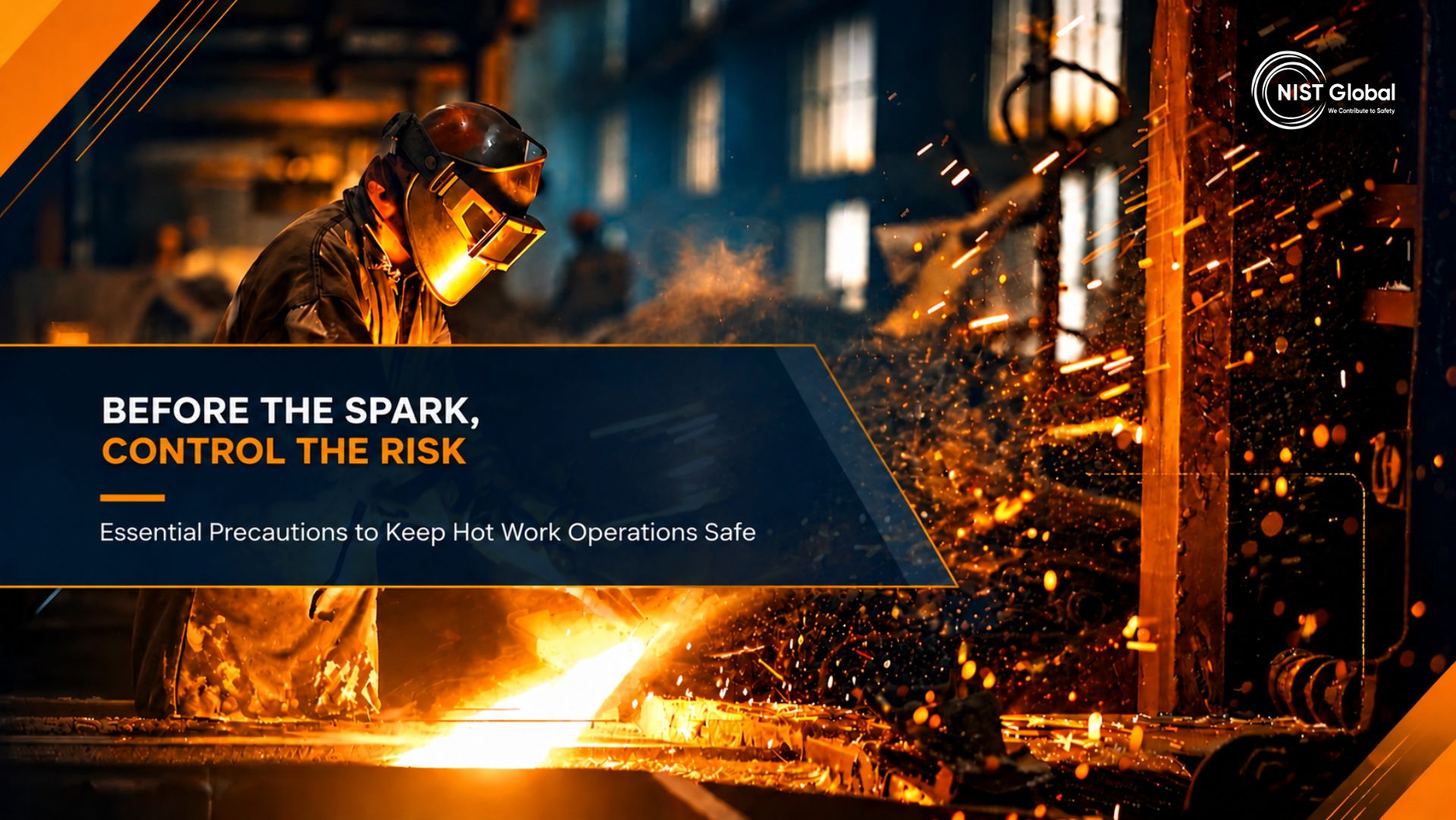
A maintenance crew starts the process of grinding a steel support girder within a manufacturing facility. Hot sparks fall silently from the steel girder into the aisle of cardboard boxes and oily rags in an adjacent storage area. Maintenance work in industries includes tasks of welding, cutting, grinding, and brazing.
But these tasks create heat sources that can easily start fires by igniting any available combustible material. The knowledge of how to control these hazards with hot work fire prevention measures will save lives and prevent downtime. In this blog, we will delve into hot work and fire prevention and the essential safety measures.
What Is Hot Work and Why Is It Dangerous?
Hot work is defined as any temporary or permanent activity involving an open flame or generating heat, sparks, and/or molten slag.
Causes of Hot Work Fires
Flying Sparks: Sparks from grinding wheels fly in the thousands of white hot sparks which can cover large distances within the open work bay.
Molten Slag: Molten slag resulting from torch cutting falls through floor grates, wall openings, and unprotected cable entries to other floors within the building.
Smoldering Spark: Molten slag or sparks fall into concealed areas where they smolder silently for hours before igniting a fire well after workers have left.
Heat Conducted: Hot work performed on metal pipes and steel beams conducts the heat to walls, igniting wall insulation and other rooms in proximity.
5-Stage Hot Work Permit System Lifecycle
An HWP system is one of the most efficient administrative control methods to avoid fire in hazardous operations. Its life cycle comprises five different stages that cannot be modified:
Stage 1: Pre-Job Risk Assessment
Before igniting the process of welding or torching, the supervisor and operator have to carry out Hazard Identification and Risk Assessment (HIRA):
- Identify any ignition sources in the area, flammable gas lines, chemical tanks, or dust sources.
- Determine whether the operation can be conducted via a cold work alternative approach (mechanical bolting, cold hydraulic cutting).
- Conduct atmospheric tests in case of operating in proximity to chemical lines, paint booths or other confined spaces.
However, in cases where there is a potential exposure to volatile organic compounds, flammable solvents, or any other combustible gas, gas testing should be continuous and not a one-off activity before starting the job.
In such an environment, gas concentrations change very quickly as one works on opening up flanges or heating up surfaces which release heat to nearby process lines. It is important to use multi-gas detectors that have been calibrated for lower explosive limits. This is because any concentration above 10% LEL stops all work.
Stage 2: Area Isolation and Preparation (The 11-Meter Rule)
Work area preparation will ensure that sparks cannot fall on fuel sources:
- Combustible Materials Removal: Remove all mobile combustible materials such as papers, packaging, wooden materials, textile cuttings, and garbage from around the work area at least 11 meters away from the work point.
- Protect Immovable Sources of Danger: In case of immovable equipment and materials, they must be adequately covered with certified fireproof fire blankets or welding screens.
- Cover Openings: Floor drains, wall openings, and other pipe openings should be covered with fire blankets to prevent hot slag from falling to a lower level.
- Energy Lines LOTO: Fuel, gas, and other chemical lines should be isolated and vented of any pressure present in the lines.
- Firefighting Equipment Placement: The fire equipment, including firefighting extinguishers, should be available near the workplace.
Stage 3: Permit Authorization
Walkthrough is done by the PAI or the safety officer to ensure that all controls have been checked before issuing the permit:
- Equipment such as hoses, cylinders of gas, electrical wiring, and earth clamps should be in good condition and safe to use.
- Workers should be wearing fire-resistant personal protective equipment (PPE), which includes welding jackets, flame-retardant gloves, face shields, and safety boots.
- Authorized time, location, and personnel should be recorded on the permit form and placed in a prominent position close to the work area.
Stage 4: Execution and Active Fire Watch
It is mandatory to have the fire watch monitor present until the end of the entire hot work process:
- The fire watch must pay full attention to the detection of sparks, slag, smoke, and smoldering materials (fire watch monitors cannot do other job-related activities when doing fire watch).
- Be prepared to use the firefighting equipment in case there occurs any kind of incipient fire.
- Raise the fire alarm in case of a spreading fire.
Stage 5: Post-Job Inspection and Permit Closeout
The majority of hot work fires occur after completion of the task. It is important to ensure proper site safety after closeout:
- Keep Fire Watch: Ensure that there is an uninterrupted fire watch of a minimum of 30 to 60 minutes post-welding/cutting to identify any smoldering hot spots.
- Perform Final Thermal Inspection: Use thermal imaging camera to inspect the working area, surrounding areas, bottom floors of the building, and behind the partitions for residual heat/embers.
- Remove Isolations: Remove temporary covers, re-isolate energies, return PPEs, and sign out the permit form to return the workspace.
Hot Work Fire Prevention Controls Matrix
The operational checklist consists of fundamental controls during routine industrial operations:
-
Hot Work Activity
Primary Fire & Explosion Hazards
Essential Area Controls
Required Protective Gear & Tools
Electric Arc / MIG / TIG Welding
Flying spatter, electrical shorts, cable overheating, radiation.
Dry floor surface, isolated earthing, fire blankets within 11m.
Shade-appropriate welding helmet, leather gauntlets, fire-resistant apron.
Oxy-Fuel Torch Cutting
High-temperature slag drops, fuel gas leaks, blowback.
Flashback arresters on torches and regulators, upright cylinder securing.
Cutting goggles, leather spats, Class B fire extinguisher on standby.
Angle Grinding & Metal Cutting
High-velocity spark showers, disc shattering, dust ignition.
Spark shields, sealed floor drains, cleared combustible trash.
Full face shield over safety glasses, leather gloves, spark deflectors.
Brazing & Pipe Sweating
Open flame exposure, pipe heat conduction through walls.
Heat-shielding blankets behind pipes, clear wall partition spaces.
Flame-resistant clothing, nearby water hose or pressurized extinguisher.
Regulatory and Legal Standards for Hot Work Safety
A permit system for hot work should be in compliance with the applicable hot work safety regulations and standards:
- Factories Act, 1948 (Sections 37 and 38): Addresses explosion prevention and fire safety precautions.
- BOCW Rules: Establish construction-site safety and fire prevention requirements.
- OSHA 29 CFR 1910.252: Specifies precautions for welding, cutting and brazing, including fire watch requirements.
- ISO 45001:2018 (Clause 8.1.2): Focuses on eliminating hazards and reducing OH&S risks.
Regular audits of active and closed Hot Work Permits help identify gaps in hazard assessments, fire watch sign-offs and post-work fire monitoring.
Common Mistakes That Cause Hot Work Fires
Adhering to operational standards will keep facility risks at their minimum:
A. Permit Skirting “Quick Jobs”: Performing a five-minute grinding or tacking welding job without the issuance of a permit and without looking for any flammable materials around.
Correction: Make it mandatory that a zero-tolerance approach be used whereby every sparking activity needs a permit check.
B. Leaving Fire Watch Before Time: Walking away from the work station immediately after completing the welding job without being aware of any smoldering embers.
Correction: A strict 30-60 minute fire watch should be done before the closing off of every permit.
C. Overlooking Invisible Fire Passages: Placing shields on all the storage boxes but not paying attention to floor drains or walls.
Correction: Cover up all possible passages in the 11 meter safety zone with fire blankets.
D. Fire Watch Monitor Being Involved in Other Activities: Making the fire watch monitor do other things such as getting tools and grinding along with monitoring for sparks.
Correction: Fire watch duties should not overlap with any other activities.
Strengthen Workplace Safety with NIST Global
The management of fire hazards in hazardous activities necessitates professional advice and safety skills training. The following are some of the safety solutions offered by NIST Global that ensure the development of safety discipline in industrial sites:
- NIST Global Hot Work Safety Training: Safety training program that teaches managers and workers on pre-task hazard assessment, area preparation, permit management, proper use of fire-resistant PPE, and fire watch.
- Permit To Work (PTW) Program Implementation: Professional advice in designing, auditing, and optimizing the permit system on-site according to national laws and international standards.
- On-site/Virtual Custom Site Simulation: Hands-on safety training on-site or virtually that enables workers to identify latent sources of fire hazards and use firefighting equipment efficiently.
Join hands with NIST Global Hot Work Safety Training to prevent fire hazards and ensure complete compliance with regulations.
Key Takeaways
- Fires can result from sparks, molten slag and heat transfer from hot-work activities like welding, cutting and grinding.
- A five-stage Hot Work Permit system assists in the process of risk assessment, area preparation, authorisation, fire watch and post-work inspection.
- Shield combustible materials, isolate hazardous energy sources and ensure proper fire extinguishing equipment is easily available.
- During hot work, there is a risk of the work causing ignition and fire watchers should remain alert to the possibility of ignition after the work has been completed.
- Frequent permit audits and fire safety training enhance fire prevention and workplace safety compliance.
FAQs
Popular Safety Training Programmes
Behaviour Based Safety Training
Develop safe behaviours, strengthen safety culture, and reduce workplace incidents through proactive observation and intervention.
Fire Safety Training
Equip employees with the knowledge and practical skills to prevent fires, respond effectively, and protect people and assets.
Defensive Driving Training
Improve driver awareness, reduce road risks, and promote safer driving practices for employees operating vehicles.
The Right Safety Training Could Prevent the Next Workplace Incident
Explore our comprehensive range of workplace safety training programmes designed to reduce risks, strengthen safety culture, and improve workforce competence across all levels of your organization.