
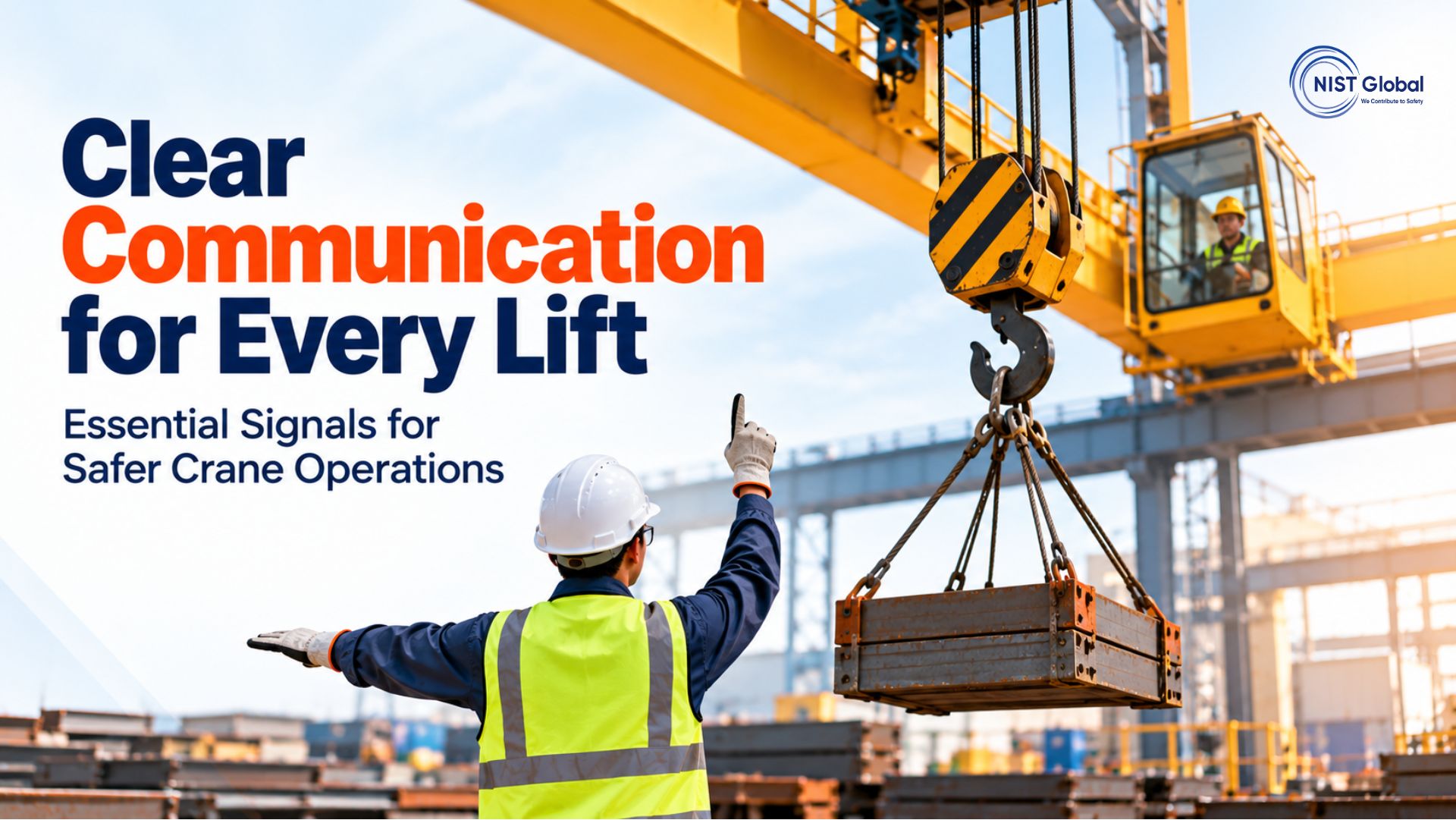
Cranes employ hand signals that involve physical movements used in directing the cranes’ operators. The standard hand signals reduce the chances of any misunderstandings arising from noise and crowd, leading to the risk of a dropped load, collisions, and harm to personnel working in the construction area.
This document describes the standardized hand signals used by the cranes according to OSHA and ASME guidelines, and the roles of banksman and signaling persons during the various stages of lifting operations.
What are Standard Crane Hand Signals?
The standardized crane signals are those which have already been defined, being non-verbal instructions for the cranes which give directions as to where precisely the boom, hoist line, and superstructure of the cranes should be positioned. This is due to high noise levels in the machinery, distance, and other environmental conditions.
Standardized Crane Hand Signals Chart
The following standardized hand signals have been specified in OSHA 29 CFR 1926 Subpart CC, ASME B30.5 and IS 13367:
| Signal Function | Physical Gesture Description | Crane Operator Action |
|---|---|---|
| Hoist (Raise Load) | Forearm vertical, index finger pointing up, move hand in small horizontal circles. | Raises the hoist line smoothly. |
| Lower Load | Arm extended downward, index finger pointing down, move hand in small horizontal circles. | Lowers the hoist line smoothly. |
| Raise Boom | Arm extended horizontally, fingers closed into a fist, thumb pointing upward. | Luffs the boom up (increases boom angle). |
| Lower Boom | Arm extended horizontally, fingers closed into a fist, thumb pointing downward. | Luffs the boom down (decreases boom angle). |
| Swing Boom | Arm extended horizontally, index finger pointing in the direction of the swing. | Slews the superstructure in the indicated direction. |
| Stop | One arm extended horizontally, palm facing down, sweep arm back and forth laterally. | Stops all current crane movement immediately. |
| Emergency Stop | Both arms extended horizontally, palms facing down, sweep both arms back and forth laterally. | Stops all crane functions instantly. |
| Dog Everything | Clasp hands together firmly in front of the body. | Engages mechanical brakes to hold the load statically. |
| Travel (Both Tracks) | Rotate both fists around each other in front of the body. | Drives crane tracks forward or backward. |
| Telescope Boom Out | Both fists held in front of the body with thumbs pointing outward away from each other. | Extends hydraulic boom sections. |
| Telescope Boom In | Both fists held in front of the body with thumbs pointing inward toward each other. | Retracts hydraulic boom sections. |
What are the Core Responsibilities of a Banksman and Signalman?
The role of the banksman or signaller is to be the eyes and ears of the crane operator on the ground, ensuring full vigilance at all stages of the operation. This includes before lifting, during lifting, and when the load lands.
1. Pre-Lift Assessment and Site Preparation
- Check for Line of Sight: Ensure there is line of sight from the operator’s cabin, signaler’s position, and load movement path.
- Establish Exclusion Zone: Provide exclusion zones around the swing radius of the crane and the travel pathways of the crane.
- Environmental Conditions: Inspect the environmental conditions such as windspeed, visibility, ground stability and power line clearance to ensure safe operation.
- Voice Communication Channels: When using radio communication, check that the communication channels are clear of interference.
2. Active Lift Direction
- Maintain Single Control: Be the lone controller of crane motions during lifting and moving processes.
- Control Tagline Workers: Direct tagline workers to rotate the load and keep its drift under control without allowing people to be below the load.
- Handle Blind Lifts: Control blind lifts where loads move through openings in walls, hatch covers, and elevated decks via radio or relay.
- Keep Constant Communication: Keep communications going; operations have to cease when line-of-sight and/or radio contact is lost.
3. Post-Lift and Landing Safety
- Final Load Positioning: Guide the crane operator to place the load down gently on either dunnage or staging mats.
- Unhook Authorization: Instruct riggers to unhook the slings and shackles once the load is firmly placed.
- Remove Hook Block from Rigging: Indicate to the operator to lift the empty hook block off the ground before the next operation begins.
3 Non-Negotiable Rules of Crane Signaling
Strict adherence to the set of standard signal codes ensures safety and eliminates confusion:
Rule 1: The “One Signalman” Concept
A single signalman directs the crane’s motions at all times. Should there be more than one person starting the motions of the crane, the operator should stay where he is until one signalman takes control.
The Safety Exception: Any individual working on the site can give the “Emergency Stop” signal in case of danger. The crane operator should heed the emergency stop signal no matter who gave it.
Rule 2: The Continuous Communication Protocol
While conducting voice-controlled or radio-controlled tasks, constant and descriptive communication is required (for example, “Hoisting… hoisting… 4 feet… 2 feet… stop”). Even when the radio signal drops out for just one second, all functions of the crane should stop working until voice communication is restored.
Rule 3: The “When in Doubt, Stop” Rule
In case of any unclear hand signal, it should be considered by the operator as a command for an instant stop. The use of guesswork while operating lifting equipment is forbidden.
Standard vs. Critical Lifts: How Signaling Protocols Scale
As complexity and danger levels grow with lifts, signals evolve from regular visual indicators to specially designed interlocking communications systems:
| Operational Parameter | Standard Lift (Line-of-Sight) | Critical / Complex High-Risk Lift |
|---|---|---|
| Communication Method | Standard visual hand signals or direct line-of-sight cues. | Hands-free, dedicated two-way radios on isolated channels. |
| Signalperson Credentials | Certified Signalperson / Site Banksman. | Senior Certified Signalperson qualified in lift plan execution. |
| Pre-Lift Documentation | Standard pre-shift inspection checklist and pathway check. | Formal 3D lift plan review, toolbox safety brief, and radio checks. |
| Blind-Spot Provisions | Secondary relay signaller for brief blind transitions. | Multiple dedicated relay signallers using linked radio loops. |
| Power Line Clearances | Standard visual clearance buffer (minimum 10 ft / 3 m). | Dedicated spotter assigned solely to monitor electrical line proximity. |
Key Regulatory Standards Governing Crane Signaling
Industrial signaling systems have been codified around the world via safety codes at the national and international levels:
- OSHA 29 CFR 1926.1419 – 1422 & 1428 (USA): Requires signaling qualification standards, sets out standard hand and voice signaling procedures, and sets down communication requirements for construction cranes.
- ASME B30.5: Describes standardized hand signals, signaling procedure between operator and signalperson, and emergency procedures for mobile and locomotive cranes.
- Indian Standard IS 13367 (Part 1): Code of practice for safe use of cranes, including the functions of banksman, signal procedures, and travel path clearance procedures.
- UK HSE BS 7121: Codes of practice for the safe use of cranes, clearly separating the roles of lifting teams, slingers, and banksmen.
4 Common Signaling Errors and How to Prevent Them
| Signaling Error | Root Hazard | Corrective Safety Action |
|---|---|---|
| Poor Signal Visibility | Standing in shadows, behind plant machinery, or wearing dark clothes that obscure gestures. | Wear high-visibility vests, reflective armbands, and contrast gloves; stand in clear view of the cab. |
| Using Non-Standard Gestures | Relying on informal, local hand signs that confuse operators trained on standard charts. | Enforce strict compliance with OSHA, ASME, and IS standard hand signal charts across all site lifts. |
| Losing Contact on Blind Picks | Stepping outside the operator’s line of sight without active radio contact. | Immediately halt the crane if line of sight is broken until voice or visual communication is restored. |
| Multi-Tasking While Signaling | Attempting to hold taglines, adjust rigging, or make phone calls while directing crane movement. | Keep the roles of signalperson and rigger strictly separate during active crane movements. |
Advance Your Site Safety Standards with NIST Global
Incident-free lifting operations demand proven communication techniques, practical training, and compliance with safety regulations. NIST Global provides accredited safety training courses for industrial and infrastructure operations including:
- Banksman & Signalman Training Course: Practical training in the use of standard hand signals, radios, blind lift and exclusion zone management.
- Lifting & Rigging Proficiency Course: Practical training in rigging teams in load calculation, rigging equipment testing, hitches, and tagline management.
- Lifting Safety Audit: Site visits to check on crane operation procedures, signaling, and compliance with OSHA and IS requirements.
Get in touch with NIST Global to book accredited banksman and signalman training courses for your team.
Key Takeaways
- Operational Linkage: Standardized hand signals link the crane operator and the banksman on sight and sound barriers.
- One Signalman Principle: Only one signalman can coordinate the activity of a crane, except when giving the Emergency Stop signal which should be adhered to immediately regardless of who gives it.
- Continuous Communication: For blind lifts and radio operations, continuous communication becomes compulsory; any one second delay in communication should force the crane to stop immediately.
- Standard Procedures: Hand signals and communication procedures should strictly follow OSHA 29 CFR 1926.1419–1422, ASME B30.5, BS 7121, and IS 13367 standards.
- Accredited Training: NIST Global provides professional banksman and signalman training courses to ensure lifting personnel hand signaling and communication proficiency.
FAQs
What is the difference between a banksman and a signalman?
Even though the two terms are often confused and interchangeable, the scope of their work differs per jurisdiction:
- A banksman (used in the UK, offshore, and internationally) typically oversees vehicle movement, site traffic, crane movement, and slinging work.
- A signalman (signalperson) only handles crane movement, boom control, and hoisting work using standard signals.
Who can give an Emergency Stop signal?
Anyone who observes a dangerous situation at the site is allowed to give the Emergency Stop signal. It is the responsibility of the crane operator to stop all movements at once irrespective of who has issued the signal.
What should a crane operator do if he/she cannot see the signalman?
All crane movement must be stopped immediately. Movements can only commence after the operator regains clear sight of the signalman.
Does OSHA demand that crane signalpersons obtain certifications?
Yes. According to OSHA standard 29 CFR 1926.1428, signalpersons have to be assessed and certified by any approved outside body or an internal qualified assessor to prove proficiency in hand signaling, vocal communication, and fundamental crane operation.
When is two-way radio communication necessary rather than hand signaling?
The two-way radio is required when there is no direct line of sight between the operator and signalperson, during night time or foggy weather conditions, inside complicated industrial plants, or at long distances where the hand movements cannot be understood effectively.
Popular Safety Training Programmes
Behaviour Based Safety Training
Develop safe behaviours, strengthen safety culture, and reduce workplace incidents through proactive observation and intervention.
Fire Safety Training
Equip employees with the knowledge and practical skills to prevent fires, respond effectively, and protect people and assets.
Defensive Driving Training
Improve driver awareness, reduce road risks, and promote safer driving practices for employees operating vehicles.
The Right Safety Training Could Prevent the Next Workplace Incident
Explore our comprehensive range of workplace safety training programmes designed to reduce risks, strengthen safety culture, and improve workforce competence across all levels of your organization.