
A worker wears the right PPE, follows the procedure, and completes the task safely. Another worker, doing the same job, takes a shortcut because the task is repetitive, the work area is inconvenient, or production is running behind schedule. These everyday behaviours can have a direct impact on workplace safety.
The scale of workplace safety challenges remains significant. The International Labour Organization (ILO) estimates that 2.93 million workers die each year as a result of work-related factors, while 395 million workers sustain non-fatal work injuries annually.
This is where Behaviour-Based Safety (BBS) observations become valuable. The observer uses what they see as an opportunity to start a constructive conversation with the worker.
The process is simple: observe the behaviour, have a respectful conversation, understand what influenced the action, and encourage a safer way of working. Over time, these conversations can help workers recognise risks, reinforce good practices, and develop safer habits.
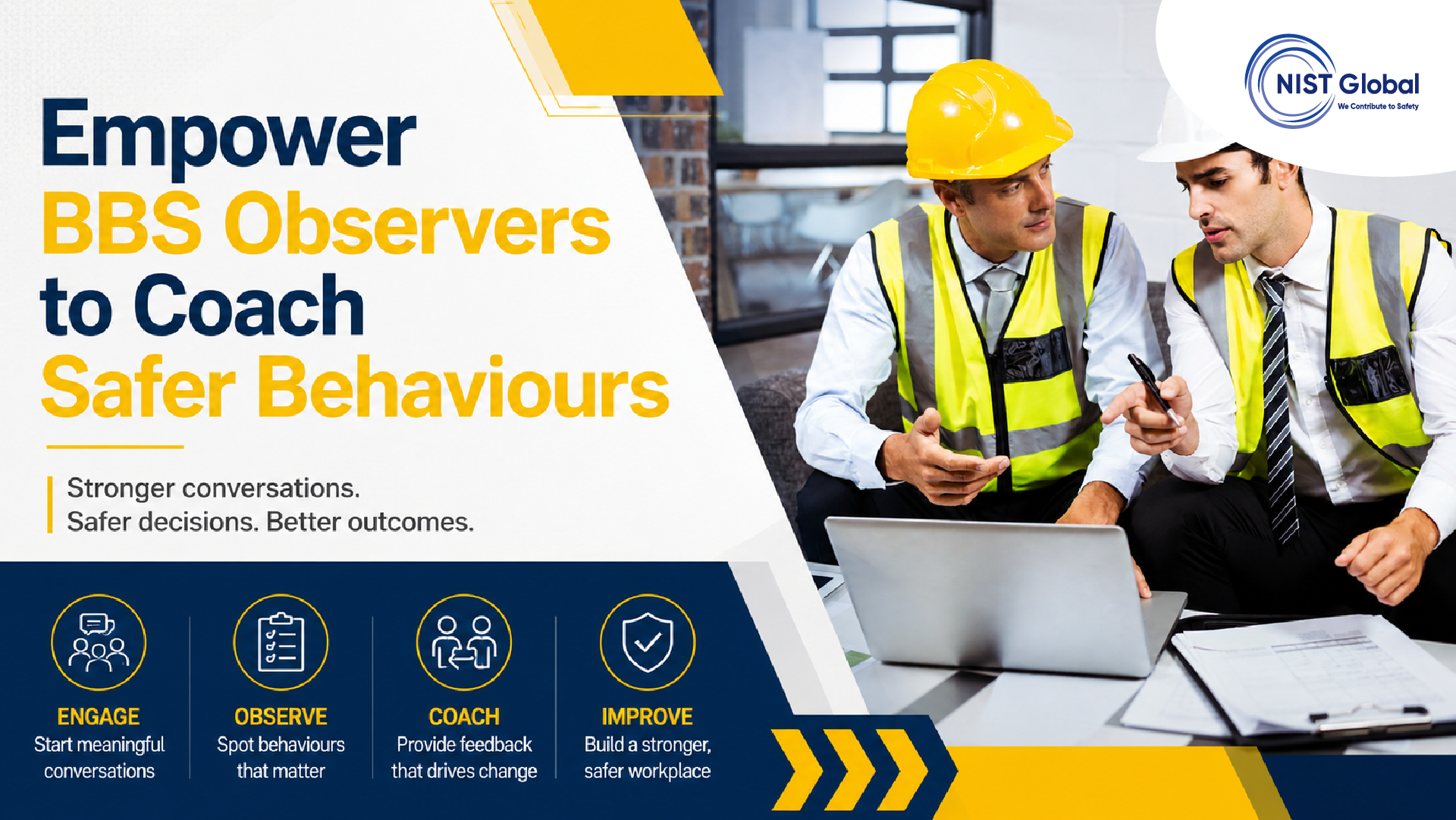
Safety observers therefore play an important role in turning workplace observations into meaningful safety improvements. They observe work activities, identify safe and at-risk behaviours, listen to workers, provide constructive feedback, and help address the factors that influence everyday decisions.
Effective BBS coaching is not about finding fault or catching people doing something wrong. It is about using observations to understand behaviour, solve problems, and encourage safer choices before an incident occurs.
Introduction to Behaviour-Based Safety (BBS)
BBS is a proactive approach to improving workplace safety. It focuses on how people make decisions and perform tasks in everyday work situations.
BBS observations generally focus on two categories of behaviour:
- Safe behaviours: Behaviours that are in accordance with safety guidelines and ensure protection against injuries.
- At-Risk behaviours: Behaviours or actions that increase exposure to hazards or the likelihood of an unwanted event.
Core Purpose of the BBS Observer
Safety observers are experienced employees who conduct peer-to-peer safety observations. They may be either front-line employees, team leaders, or supervisors.
It is not an observer’s responsibility to control and punish other workers. The observer should observe work practices, listen to worker suggestions, provide effective coaching, help identify potential hazards, and encourage safer behaviours.
What Is Safety Coaching in BBS?
Safety coaching is a dialogue between the observer and the worker being observed. The dialogue should take place immediately after a safety observation.
It is not a one-sided speech about dangers. It is an open discussion when the coach asks questions, listens to objections and gives suggestions.
Key BBS Coaching Skills
Appropriate BBS coaching skills ensure that the observer gives feedback in a way that does not annoy the worker. The following is a list of skills that every safety coach must know:
1. Start with Positive Reinforcement
Begin the conversation by reinforcing safe behaviours. Observe small details such as correct PPE usage, proper body positioning, and cleanliness around the workplace.
Positive reinforcement establishes trust quickly. The employee will be more open to discussing at-risk behaviours later during the discussion.
For instance, “I observed the way you maintained a clean workspace when operating the saw. This eliminated any risk of trip hazards.”
2. Be Observational Rather Than Judgmental
In discussing an at-risk behaviour, be observational by describing the physical activity and not the intention behind the activity.
Do not judge the attitude or personality of the worker. Refrain from saying things like, “You were being careless.”
Instead, give factual observations: “I noticed that you lifted that box without bending your knees.”
3. Ask Open-Ended Questions
Ask open-ended questions to prompt workers to discuss their decisions. The questions with “what,” “how,” or “why” can uncover operational problems hidden from the eyes.
This approach allows workers to find better solutions independently.
- Good Question: “What was challenging about using the ladder extension when fixing that problem?”
- Not Good: “Why have you not followed the ladder safety guideline?”
4. Separate the Problematic System from the Human Error
Workers are usually prone to risky behaviour due to malfunctioning equipment, insufficient lighting conditions, or deadline pressure. This is what happens behind the scenes.
Good BBS coaching techniques can tell whether the reason behind some particular behaviour is a bad practice or a system defect. In case there is a problem with some equipment, do not blame the worker but solve the issue with equipment.
5. Get Commitment for Future Behaviour
At the end of each coaching process, reach a mutual agreement. Ask the worker to commit to implementing the desired behaviour in the future.
Keep your agreements realistic, clear, and easily implementable in the next shift.
- Example: “Could we make an agreement to put on your safety gloves before doing the next cut?”
Feedback Techniques for Observers
The giving of feedback is an art and involves both skill and communication. This table highlights various feedback techniques that either support or hinder safety improvement:
| Evaluation Parameter | Effective Feedback Technique | Ineffective Approach |
|---|---|---|
| Timing | Delivered immediately after the observation. | Delayed for several days or weeks. |
| Focus | Specific, observable safe behaviours. | Vague, general statements like “be careful.” |
| Tone | Constructive, supportive, and respectful. | Critical, aggressive, or condescending. |
| Ownership | Guided dialogue with joint problem-solving. | One-sided lecture with strict demands. |
| Goal | Long-term habit change and worker protection. | Quick compliance out of fear of punishment. |
The Human Factors in BBS Coaching
Some of the common human factors that impact employee work practices include:
- Fatigue: Fatigued employees find it hard to concentrate, are slow to react to things, and fail to see obvious dangers.
- Rushing: High production targets make workers cut corners and avoid some safety measures.
- Complacency: Workers with experience may lose sight of dangers since they do the same job every day without any issues.
- Frustration: Frustration caused by faulty equipment and cluttered workspace leads workers to act on impulse.
Handling Coaching Issues in BBS Observers
The safety observer usually experiences resistance or barriers when coaching. Below are ways an observer should address common coaching issues:
Issue 1: “You Are Observing Me So That I Get in Trouble”
- Solution: Explain how the organisation’s BBS programme handles observation data and reinforce that the purpose is to improve safety rather than simply identify people to blame
Issue 2: “I Am Too Busy to Engage in Safety Conversation”
- Solution: Be brief and to the point when observing. Keep routine coaching conversations brief and focused, while allowing more time when a significant risk or underlying issue needs to be addressed. Focus on just one positive safe act and one improvement area.
Issue 3: “Observers Are Uncomfortable Coaching Friends”
- Solution: Conduct refresher BBS observer training to develop coaching skills. Give script guidelines and use friendly open-ended questions.
BBS Data as Leading Indicators
One of the primary benefits of behaviour-based safety coaching is the fact that it is constantly generating safety information.
The data gathered from safety observations represents an excellent source of leading indicators. Leading indicators assess the performance and proactive actions before incidents happen. They differ from lagging indicators that only measure incidents and injuries after they occur.
There are several important operational benefits to monitoring leading indicators:
- Identify behaviour trends: High number of at-risk behaviours will indicate hazardous trends before an accident occurs.
- Helps with Training Needs Assessment: If there is poor compliance with eye protection during the observations, then it is clear that there is a need for a specific training session.
- Assesses Safety Coaching Effectiveness: Regularly conducted observations prove that coaching takes place.
Conclusion
One of the most successful ways to prevent workplace accidents is behaviour-Based Safety (BBS). The effectiveness of a BBS programme depends partly on how well observers are trained to conduct observations and coach workers.
It is important to emphasize the importance of positive reinforcement as it will allow observers to create trust, uncover hidden risks, and deal with at-risk behaviours effectively. Knowing about human factors and leading indicators makes safety professionals able to solve issues prior to any injury.
By investing in thorough BBS observer training and learning safety coaching techniques, it is possible to make the work process safer for everyone.
Build Better Safety Observers with NIST Global
Effective Behaviour-Based Safety depends on more than conducting observations. It requires trained observers who can recognise safe and at-risk behaviours, communicate effectively, coach without confrontation, and turn observation findings into meaningful safety improvements.
NIST Global’s Behaviour Based Safety Observer Training is designed to develop these practical capabilities in frontline supervisors, safety champions, EHS professionals, team leaders, and selected employees responsible for workplace observations. The programme covers observation techniques, behavioural awareness, positive reinforcement, coaching and feedback, data recording, and practical observation skills.
With virtual or face-to-face delivery, customisation for different industries, and English and regional language options, the training can be aligned to your organisation’s workforce, operational risks, and safety objectives.
Equip your safety observers with the skills to observe, coach and influence safer behaviour.
Key Takeaways
- Behaviour-Based Safety (BBS) deals with employees’ decisions, activities, and behaviours to ensure a safe working environment.
- The role of safety observers is to perform safety observation in order to monitor safe behaviour and address any at-risk behaviour.
- Coaching for safety must rely on positive reinforcement to foster reliability of safe behaviour among employees.
- Good feedback methods help develop trust and minimize resistance to change within the entire safety culture.
- BBS metrics serve as leading indicators in preventing hazards from becoming an injury.
FAQs
Popular Safety Training Programmes
Behaviour Based Safety Training
Develop safe behaviours, strengthen safety culture, and reduce workplace incidents through proactive observation and intervention.
Fire Safety Training
Equip employees with the knowledge and practical skills to prevent fires, respond effectively, and protect people and assets.
Defensive Driving Training
Improve driver awareness, reduce road risks, and promote safer driving practices for employees operating vehicles.
The Right Safety Training Could Prevent the Next Workplace Incident
Explore our comprehensive range of workplace safety training programmes designed to reduce risks, strengthen safety culture, and improve workforce competence across all levels of your organization.