
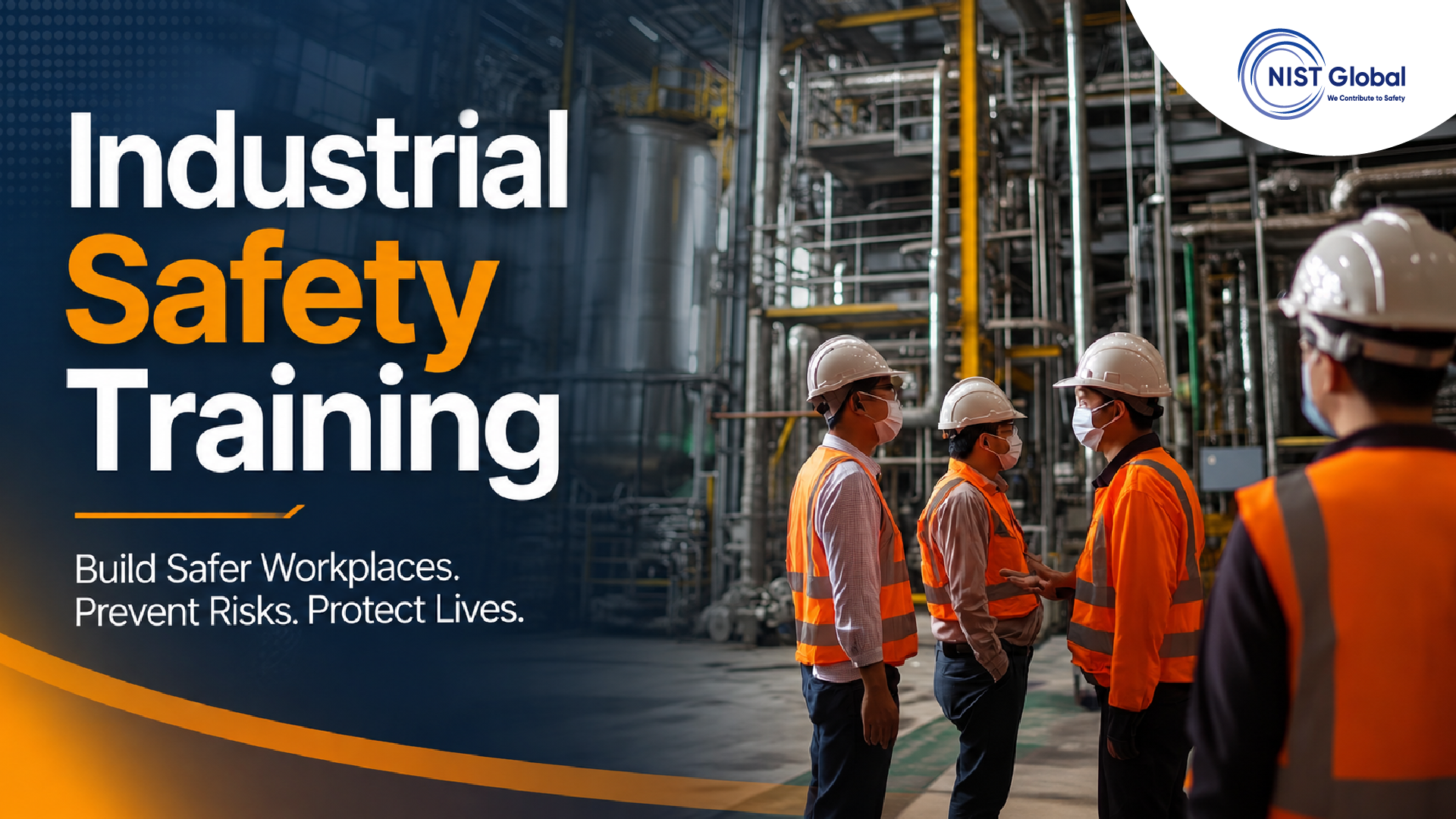
It takes just one unsafe act to turn a normal workday into a life-changing incident. Despite advancements in workplace safety, accidents continue to occur across industries due to human error, unsafe behaviors, limited hazard awareness, and inadequate training.
Ensuring a safe workplace environment goes beyond having good safety protocols and wearing protective gear. It also calls for the capability of the workers to recognize any potential hazard, adopt proper safety procedures, and act confidently in any emergency scenario. This is where Industrial Safety Training comes into play.
Our comprehensive industrial safety training program will not only help your organization to minimize risks at work but also contribute towards the development of safety culture and compliance within your organization. We provide industry-specific workplace safety training at NIST Global.
What Is Industrial Safety Training?
Industrial Safety Training refers to a systematic learning process that aims to teach the employees how to identify risks, safe work practices, emergency response, and compliance with the regulations. The main goal of the training process is to prevent work-related accidents, illnesses, and injuries through safe work practices in any organization.
The reason for providing industrial safety training to the employees is to create safety awareness among workers, recognize risks, and help workers understand their obligations in creating a safe work environment.
Industries that commonly implement workplace safety training include:
- Manufacturing
- Construction
- Oil and gas
- Pharmaceutical and chemicals
- Logistics and warehousing
- Utilities
- Mining
- Engineering and heavy industries
Whatever the industry, any company will definitely benefit from safety training of its employees.
Why Industrial Safety Training Is Important
The importance of industrial safety training extends beyond meeting regulatory requirements. It helps organizations create safer workplaces while improving operational performance.
Through well-formulated industrial safety programs, organizations can be able to:
- Cut down workplace accidents and injuries by practicing safe work behaviors.
- Improve their employees ability to identify and control workplace risks.
- Ensure regulatory compliance in occupational health and safety matters.
- Cut down the amount of machinery damage and disruption of the work process.
- Boost the workers level of confidence in both regular and emergency situations.
- Encourage a safety culture among the employees whereby they take part in risk management.
- Lower claims for compensation and the business expenses that come with it.
Employees who are aware of the workplace risks and how to handle them will ensure fewer accidents and increased productivity.
Common Workplace Hazards and Essential Safety Training
Industrial workplaces expose employees to different types of hazards, making workplace hazard training an essential part of every safety strategy.
Some of the common workplace hazards include:
- Hazards from fire and explosions
- Hazards from electricity
- Chemical hazards
- Hazards arising from machinery and equipment
- Ergonomic risks and manual handling hazards
- Workplace hazards at height
- Hazards associated with confined space entry
- Hazards due to vehicle movement
- Hazards associated with slips, trips, and falls
In order to mitigate such hazards, organizations must provide specialized industrial safety training, which includes:
- Safety induction training for new employees
- Fire safety training
- Electrical safety training
- Chemical safety and hazardous substance handling training
- Behavior-based safety training (BBS)
- Hazard Identification and Risk Assessment (HIRA)
- Permit to work training (PTW) and lockout tag out training (LOTO)
- Workplace at height and confined spaces safety training
- First aid training
- Incident reporting and investigations
- Personal protective equipment training (PPE)
- Defensive driving training for transport and logistics functions
Selecting the right training based on workplace risks will help organizations develop a safety management system.
Who Should Attend Industrial Safety Training?
Safety is the duty of all individuals. Thus, the process of industrial safety training for employees should not be restricted just to frontline employees.
Industrial safety training should be provided to:
- Employees engaged in day-to-day activities
- Contract workers
- Temporary workers
- Supervisors
- Line managers
- Engineers and maintenance staff
- Safety professionals
- New employees via safety induction training
Role-specific training helps in ensuring that each employee is aware of the dangers at the workplace.
How Often Should Employees Receive Safety Training?
Training on workplace safety needs to be ongoing and not a one-off task.
Training should be carried out:
- During employee induction
- As part of refresher courses periodically
- When new equipment or procedures are introduced in the workplace
- In case of any incident at the workplace
- Following a change in workplace safety policies or laws
Consistent training helps all the employees to stay updated with evolving workplace risks and enhance safe work behaviour.
Best Practices for Effective Industrial Safety Training
Effective industrial safety training should not involve just classroom lectures. Organizations need to consider methods of learning that will enhance knowledge retention and develop safe behavior.
The following are some of the industrial safety training practices that an organization can consider:
- Hands-on training activities.
- Mock drills.
- Using real-world accident case studies for risk assessment in workplaces.
- Testing the understanding of workers through practical evaluation.
- Fostering employee participation and discussion.
- Active management involvement in workplace safety programs.
- Reviewing the effectiveness of safety training programs.
These are some of the practices that can make employees use the acquired skills in the workplace environment.
How to Choose the Right Industrial Safety Training Provider
The choice of the appropriate training partner plays a crucial role in determining the success of workplace safety programs.
Companies need to consider the following aspects:
- Industry experience
- Experience in different industrial segments
- Customized training programs based on company risks
- Experienced trainers
- Effective learning and demonstration sessions
- Assessment and certification
- Post-training services
It is advisable to choose an experienced training partner to ensure that training is according to industry needs.
Conclusion
Safety in the industrial setting goes beyond just adhering to regulations, as it involves keeping employees safe from harm and making sure that there are no accidents in the workplace by creating a safety culture.In addition, an industrial safety program can go a long way in ensuring that organizations are able to mitigate risks and become more efficient in their operations.
Investing in industrial Safety Training means making investments in people, the continuity of the organization, and its success in terms of its operations. At NIST Global, we offer workplace safety training in the various industries. This training includes both practical and applied learning sessions delivered by experienced trainers.
Key Takeaways
- Industrial Safety Training helps employees identify hazards and work safely.
- A structured industrial safety program reduces accidents, downtime, and workplace risks.
- Regular workplace safety training improves compliance, productivity, and safety awareness.
- Training should be provided during induction, through refresher sessions, and whenever workplace risks change.
- Practical learning methods, such as hands-on exercises and mock drills, improve knowledge retention.
- Choosing the right training provider ensures industry-specific and effective safety training.
- Continuous safety training helps organizations build a stronger and more proactive safety culture.
Frequently Asked Questions
Popular Safety Training Programmes
Behaviour Based Safety Training
Develop safe behaviours, strengthen safety culture, and reduce workplace incidents through proactive observation and intervention.
Fire Safety Training
Equip employees with the knowledge and practical skills to prevent fires, respond effectively, and protect people and assets.
Defensive Driving Training
Improve driver awareness, reduce road risks, and promote safer driving practices for employees operating vehicles.
The Right Safety Training Could Prevent the Next Workplace Incident
Explore our comprehensive range of workplace safety training programmes designed to reduce risks, strengthen safety culture, and improve workforce competence across all levels of your organization.