
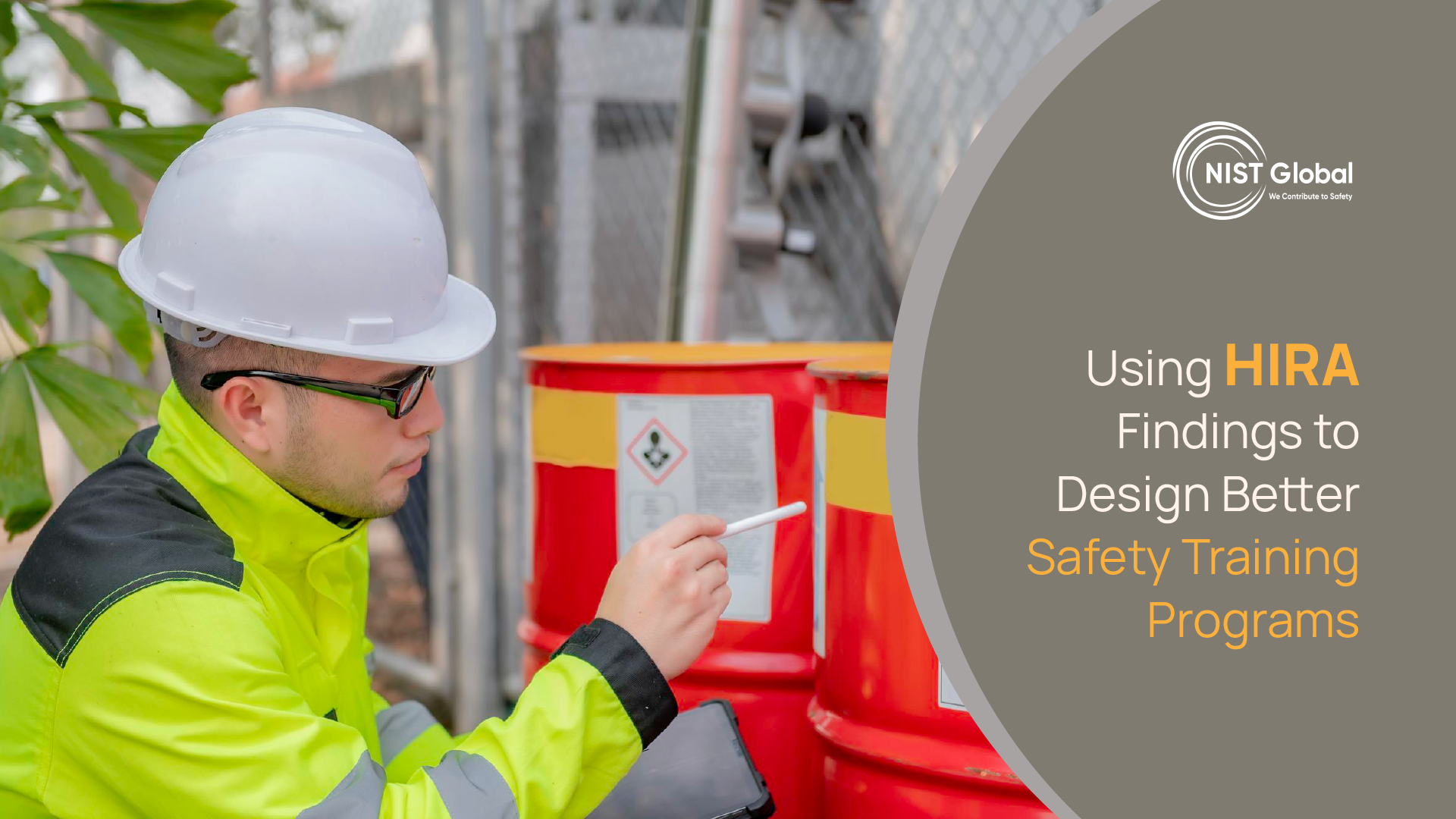
The Occupational Safety and Health Administration (OSHA) highlights employee training as a critical component of Injury and Illness Prevention Programs (I2P2). Effective, risk-based training helps workers recognize hazards, follow safe work practices, and prevent incidents before they occur.
Identifying hazards on the warehouse floor, chemical process bay, or engineering assembly line is only the first step in risk management. The real value lies in translating these findings into safer behaviors through targeted employee training. Yet, many organizations keep risk assessment data confined to spreadsheets with little connection to their safety training programs.
This gap not only wastes training investments but also leaves workers exposed to known risks. By integrating HIRA findings with training, Plant Managers, EHS Directors, and Operations Heads can transform generic training checklists into effective accident prevention programs.
The Operational Link: The Need For HIRA to Inform Safety Training Programs
In generic safety training programs, all hazards are accorded equal significance and thus receive the same attention, regardless of whether they are low-risk activities such as trips around the office, or high-hazard risks, such as exposure to dangerous chemicals.
Moving Beyond Generic, Compliant-only Safety Training
Generic training programs that are focused solely on compliance with regulations often become just that—a checklist for compliance to tick the boxes in front of an auditor. But when your safety training is informed by the data in your HIRA, you will have a training program that is immediately applicable to your own situation. In other words, instead of presenting theoretical ideas, your safety trainers can discuss the operational risks that your workers are facing on the job.
Improving Training Efficiency Through Effective Resource Utilization
Organizations often have limited training budgets and time constraints, making it essential to prioritize training efforts effectively.
It would not be possible to train each and every worker regarding all kinds of hazards that exist in the industry. The HIRA database serves as an effective benchmark to demonstrate the areas where training will give maximum return on investment.
Workplace Safety Stats & Analysis
Industrial statistics of recent years always highlight the importance of hazard mapping based on data and behavioral training as an effective solution to reduce the rate of incidents in companies.
-
The Real Statistics About Occupational Incidents: The International Labor Organization (ILO) reports show that hundreds of millions of workplace accidents happen each year all over the world. It is obvious that there is a need for proactive and target-oriented risk reduction rather than general safety seminars.
-
The Cost of Poor Risk Control Systems: Reports by the National Safety Council (NSC) indicate that billions of dollars go in vain due to occupational injuries, which include medical costs, loss of productivity, and administrative costs. One of the major causes of these losses is behavioral errors, which are easily preventable.
Four-Step Process: How To Convert HIRA Information into Useful Safety Training
To turn HIRA data into something useful, it is necessary to use the process of four steps.
Step 1: Filter and Sort Your HIRA Information
Do not burden your safety coordinators with an exhaustive list of low-risk hazards. Instead, evaluate your HIRA data for high-severity vectors that might cause serious injuries, contamination, or downtime.
| Identified Hazard Category | HIRA Risk Level | Targeted Safety Training Module |
|---|---|---|
|
Confined Space Entry |
High Risk (Severe / Probable) |
Authorized Entrant & Attendant Training, Gas Detection, Emergency Rescue Protocols. |
|
Live Electrical Systems |
High Risk (Severe / Occasional) |
Lockout/Tagout (LOTO) Procedures, Arc Flash Protection, Non-Conductive Rescue. |
|
Chemical Storage & Handling |
Medium Risk (Moderate / Frequent) |
COSHH Competency, Safe Chemical Transfer, Spillage Containment, Advanced Eye-Wash Use. |
|
Repetitive Assembly Work |
Low Risk (Minor / Frequent) |
Ergonomic Workspace Adjustment, Material Handling Techniques, Scheduled Stretch Routines. |
Step 2: Develop Contextual Safety Training Objectives
With the high-priority risk items identified, develop learning objectives that are clearly defined with respect to the context and specify the safe actions that employees should perform at work.
-
Generic Objective: “The employees will understand the significance of the entire Lockout/Tagout process.”
-
HIRA-Based Objective: “Before performing any maintenance activity on the Main Hydraulic Press line, engineers will successfully perform all 6 steps of LOTO process, confirm zero energy state isolation and lock their personal padlocks without any mistakes.”
Step 3: Select Suitable Training Methods in Accordance with the Level of Risk
Risk-free items can be well addressed through agile forms of communication such as toolbox talks, safety posters, and short e-learning modules. On the other hand, items with high-risk operational profiles need immersive simulation training, practical evaluation, and scenario-based training methods.
Step 4: Remain Flexible and Adaptable to Emerging Hazards
The HIRA register is a living document rather than a documentation of compliance. It is imperative that your training modules change instantly as soon as any new equipment, chemical formulations, and shift structures come about. The safety manager needs to ensure that training material is constantly revised to suit emerging conditions on the shop floor.
How NIST Global Converts HIRA Findings into Effective Safety Training
It takes specialist knowledge in the area of safety to translate complex codes of hazards into highly effective training courses. Here comes the benefit of collaborating with professionals from NIST Global.
Being the leader of safety training services in India and India’s first-ever NEBOSH Gold Learning Partner, NIST Global has over a decade’s worth of experience in safety training of organizations, HSE audit, and health and safety consulting.
Workplace Safety Training Programs Created From Your Risks
At NIST Global, we don’t just rely on static classroom lectures. Our safety professionals work hand-in-hand with your own EHS teams to create personalized safety training modules that reflect your very own NIST Global Risk Assessment & HIRA Services:
-
Tailored Scenarios: No matter whether your company handles high pressure oil and gas facilities, pharmaceutical clean rooms, or expansive logistics operations, we will create scenarios based on your unique hazards.
-
Practical Skills and Experiential Learning: At NIST Global, we focus on teaching hands-on skills over basic memorization techniques. This includes practicing actual tasks such as lockout/tagout procedures, chemical spill containment, and rescue operations, helping employees develop the confidence and competence needed to respond effectively during real-world emergencies.
-
Safety Education in Multiple Languages: For complete safety knowledge from executive managers to contractors, your customized safety training programs can be done in either English or regional languages.
Safety Training Solutions for Diverse Industrial Environments
NIST Global delivers extensive training programs that are fully accredited and are aimed at reducing identified risks through your HIRA process:
-
International Professional Certification: Courses internationally acknowledged including NEBOSH and IOSH which help develop structural safety leadership skills among your management team.
-
High-Risk Technical Training: Programs customized to high risk situations involving working at heights, industrial firefighting, confined space, and LOTO safety.
-
Behavioral Safety Programs: Training programs for enhancing safety culture where your employees transform their mindset from mere compliance into safety ownership.
FAQs
Popular Safety Training Programmes
Behaviour Based Safety Training
Develop safe behaviours, strengthen safety culture, and reduce workplace incidents through proactive observation and intervention.
Fire Safety Training
Equip employees with the knowledge and practical skills to prevent fires, respond effectively, and protect people and assets.
Defensive Driving Training
Improve driver awareness, reduce road risks, and promote safer driving practices for employees operating vehicles.
The Right Safety Training Could Prevent the Next Workplace Incident
Explore our comprehensive range of workplace safety training programmes designed to reduce risks, strengthen safety culture, and improve workforce competence across all levels of your organization.