

Even organizations with the strongest safety systems can fail to prevent accidents when unsafe behaviour becomes routine in the workplace. Many accidents happen not because rules are missing, but because risks go unnoticed, shortcuts replace safe habits, or communication breaks down. Choosing the right Behaviour-Based Safety training program is essential. It helps professionals understand risks clearly, correct unsafe behaviour effectively, and build safer habits across teams. This creates stronger accountability and long-term safety improvement.
A well-designed BBS training program helps professionals understand risks, correct unsafe behaviour, and build safer habits across teams. This guide explains the Behaviour based safety training modules, practical skills, and certification benefits. NIST Global offers industry-focused training designed for Indian workplaces to improve culture and performance.
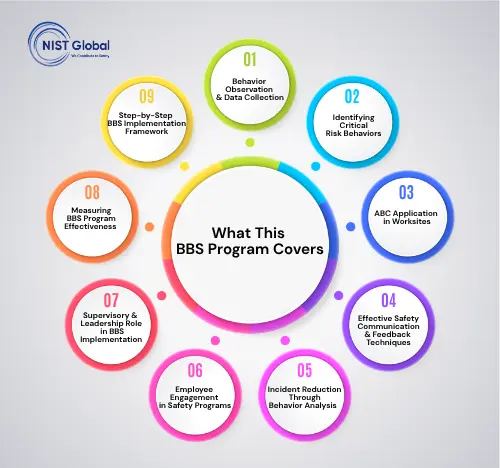
What This Behaviour-Based Safety Training Program Covers (Complete Breakdown)
A well-structured Behaviour Based Safety training program includes practical modules that help participants understand workplace behaviour, reduce risks, and improve safety performance. Each module focuses on a key area that supports long-term safety improvement.
1. Behaviour Observation & Data Collection:
Here, this program teaches the participants to carry out the structured safety observations in the real workplaces. learners will be able to understand how to create and make use of a behaviour observation checklist, apply practical safety observation techniques, and record data correctly. This approach will help the organization make a good data-driven safety decision and develop workplace observation systems.
2. Identifying Critical Risk Behaviours:
Through this program, learners will be able to identify the critical risk behaviours that often lead to incidents. This course gives more importance to spotting unsafe acts, enhance hazard identification, and use risk prioritization methods. This helps teams
3. Antecedent–Behaviour–Consequence (ABC) Application in Worksites:
Specially, this training explains how to apply the ABC model safety framework in daily operations. Learners will learn how the behaviour triggers could influence actions and how consequence management could affect future behaviour. This course will also cover simple reinforcement strategies that help employees make safer choices consistently.
4. Effective Safety Communication & Feedback Techniques:
Good communication plays a vital role in changing behaviour. This course teaches you how to give immediate and respectful feedback when unsafe actions are noticed. Participants develop safety communication, use good feedback techniques, promote peer to peer safety, and conduct behavioural coaching without creating resistance.
5. Incident Reduction Through Behaviour Analysis:
Participants learn how unsafe behaviour can lead to incidents. The training covers incident analysis, behaviour-based incident prevention, and practical corrective actions for long-term safety improvement. This helps organizations reduce repeat incidents.
6. Employee Engagement & Participation in Safety Programs:
Successful BBS programs need active employee involvement. The training shows how to improve employee engagement, safety, encourage participation programs, build safety ownership, and increase workforce involvement across all levels of the organization.
7. Supervisory & Leadership Role in BBS Implementation:
Leaders have a direct impact on workplace safety. This module focuses on safety leadership, supervisor training, clear safety accountability, and visible leadership involvement. Supervisors learn how to guide teams and reinforce safe behaviours consistently.
8. Measuring BBS Program Effectiveness:
This course explains the process of tracking the results through measurable indicators. Participants learn to use safety KPI’s, compare leading indicators, and monitor safety performance metrics over time. This helps the organizations measure the return on training investment.
9. Step-by-Step BBS Implementation Framework:
Moreover, this training also covers what happens after the completion. This strong program builds a practical implementation plan that fits their safety management system. It also support continuous development and aligns with the wider HSE framework which is already used in the organization.
BBS Training Deliverables: What You Actually Receive
An appropriate BBS training course should be more than the theory learning. Participants usually receive practical resources that they can use right away in the workplace, such us:
-
Recognized BBS certificates India.
-
Practical safety templates
-
Course manuals and useful training materials
-
Ready-to-use observation checklists
-
Implementation guidance and post-training support
-
Real case studies based on workplace incidents
All the above deliverables will help the participants apply what they learn with confidence after completing the course.
Skills & Competencies You Will Develop Through BBS Training
After completing the BBS course, all the participants could easily develop:
-
Strong foundation on behavioural skills for the workplace observations.
-
Practical safety competencies for the development programs.
-
Effective coaching skills for supervisors and teams
-
Stronger communication and reporting habits
-
Better risk assessment skills for decision-making
With all the above competencies, individuals as well as organizations could build a long-term value.
How This BBS Training Translates to Workplace Results
When an organization applies the BBS principles continuously, they often see clear and measurable improvements, such as:
-
Higher reporting and participation from employees
-
Stronger safety culture improvement across teams
-
Better employee engagement in safety activities
-
Better productivity through safer operations
-
Stronger safety culture improvement across teams
-
Improved regulatory compliance India alignment
-
Fewer unsafe acts and near-miss incidents
The overall results of the above principles are a safer workplace, a more productive workplace, and a more responsible workplace.
Who This BBS Course Is Best Suited For
This training is valuable for the following professionals:
-
HR and compliance professionals
-
HES officers
-
Team leaders
-
Safety managers
-
Operations managers
-
Site supervisors
It is highly suitable for the sectors such as construction safety, oil and gas, logistics, warehousing, and manufacturing safety in India environments.
Conclusion
A proper structure BBS training course gives the organizations the right tools to decrease the accidents, improve responsibility, and create a safer workplace with the safe workplace behaviours as it becomes the part of our everyday work. It helps the teams build observation skills, stronger leadership, better communication, and systems that support continuous development. If you are looking for practical BBS training benefits, long-term workplace safety improvement, and a clear path toward safety excellence India, choosing the right training partner is important.
NIST Global is a trusted provider of industry-focused Behaviour-Based Safety training programs designed for Indian workplaces. With practical expertise and results-driven learning, NIST Global helps organizations strengthen safety culture and improve measurable performance. Connect with NIST Global today to discuss your training needs and take the next step toward safer operations.
Key Takeaways
-
BBS training helps reduce unsafe acts and incidents.
-
It improves observation, communication, and accountability.
-
The course covers practical tools and behaviour change methods.
-
Leaders play a key role in successful implementation.
-
BBS supports a stronger safety culture and better performance.
-
NIST Global offers practical, industry-focused BBS training.
FAQs Related To BBS Training
1. What practical modules are included in a Behaviour-Based Safety training course in India?
The practical modules that are included in the Behaviour- Based safety training course are observation methods, ABC model application, communication skills, leadership involvement, metrics, and implementation planning.
2. Will I receive observation checklists and tools during the BBS training?
Yes, many professional providers include checklists, templates, and practical tools.
3. How is the ABC model applied in real workplace scenarios during training?
Participants learn to identify triggers, behaviours, and consequences using real operational examples.
4. Does the BBS course include hands-on practice or case studies?
Yes, quality programs often include exercises, workplace scenarios, and case studies.
5. What kind of certification is provided after completing the BBS training?
Most providers issue course completion or professional certification documents.
6. How can I implement BBS in my organization after completing the course?
Start with observations, identify risk behaviours, train supervisors, and follow an action plan.
7. What measurable results can be expected after BBS training?
Fewer unsafe acts, better reporting, stronger participation, and improved safety culture.
8. Is this training suitable for supervisors and frontline workers?
Yes, it is suitable for supervisors, frontline workers, and safety teams.
9. How do I evaluate if a BBS training provider is credible?
Check experience, trainer expertise, certification value, and support.
10. Does the course cover real industry-specific safety challenges in India?
Yes, many courses include practical examples relevant to Indian industries.
Popular Safety Training Programmes
Behaviour Based Safety Training
Develop safe behaviours, strengthen safety culture, and reduce workplace incidents through proactive observation and intervention.
Fire Safety Training
Equip employees with the knowledge and practical skills to prevent fires, respond effectively, and protect people and assets.
Defensive Driving Training
Improve driver awareness, reduce road risks, and promote safer driving practices for employees operating vehicles.
The Right Safety Training Could Prevent the Next Workplace Incident
Explore our comprehensive range of workplace safety training programmes designed to reduce risks, strengthen safety culture, and improve workforce competence across all levels of your organization.