
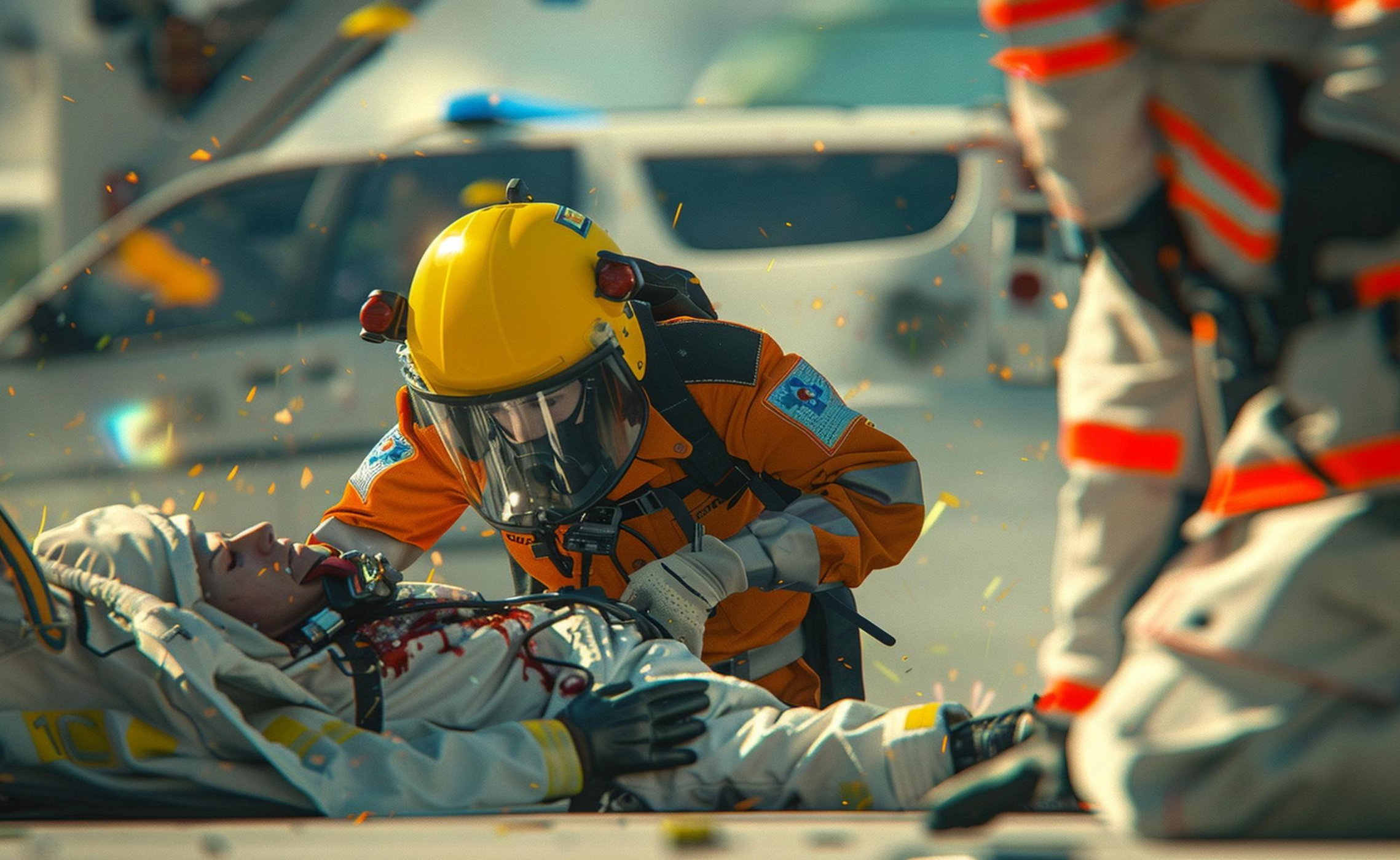
Safety is a paramount responsibility across any professional environment. Be it your high-rise corporates or a bustling warehouse or a remote construction site, you cannot go without safety. While most of us focus on fire drills and ergonomic chairs, the real safety lies in understanding and dealing with workplace medical emergencies.
India, in particular, has high stakes, with statistics of cardiovascular deaths accounting for nearly 27%. The productive age group of 30 to 60 years makes a significant portion of this death rate. Further, India accounts for approximately 11% of the global road and workplace-related trauma deaths. Yet, around 80% of them do not receive the emergency support within the ‘Golden Hour.’ (Source: National Library of Medicine)
To understand why safety matters, you should first know what the top 10 workplace health emergencies are.
Top 10 Workplace Medical Emergencies at Workplace
Below is a list of the top 10 workplace health emergencies.
1. Sudden Cardiac Arrest (SCA)
One of the most time-sensitive emergencies is sudden cardiac arrest (SCA). Malfunctioning of your heart’s electrical system is a key indicator of the SCA. It causes your heart to stop beating. In India, the survival rate of out-of-hospital cardiac arrest is quite low at 1%. Lack of an immediate bystander CPR could be one of the possible reasons here.
-
Signs: Sudden collapse on the floor, unresponsiveness, and shortness of breath.
-
Immediate Action: Immediately call emergency services. A high-quality CPR (Cardiopulmonary Resuscitation) and an Automated External Defibrillator (AED) are the only possible ways out here. This combined therapy is effective in restoring your heart rhythm.
-
Why Training Matters: Modern training (First Aid, CPR, and AED) ensures that your employees know exactly where your office AED is located. These trainings empower them to effectively use the voice-guided prompts to save a life.
2. Choking
Choking is quite common in your office pantries and cafeterias. A piece of food can easily block your airway, leading to an unconscious state within minutes.
-
Signs: Hands clutched to the throat is one of the most ‘universal choking signs.’ Inability to speak and a panicked expression are among the other signs.
-
Immediate Action: Make the victim cough. If they cannot cough, try abdominal thrusts or the Heimlich manoeuvre. Infants can be immediately rescued using back blows and chest thrusts.
3. Heart Attack
Heart attacks differ from cardiac arrest. In this condition, you are dealing with a ‘circulation problem’ where the blood flow to your heart is blocked. However, you are still conscious of your surroundings.
-
Signs: The visible signs of a heart attack are tightness, squeezing or pain in the chest. The pain starts from the centre of your chest and radiates towards your jaw, neck or left arm. Other signs include cold sweats and nausea.
-
Immediate Action: As an immediate action, the victim should stay calm and seated in a comfortable position. The ‘W’ position is the most preferred position where you sit up with your knees bent. Immediately seek medical assistance. In case the victim is not allergic, assist them in taking their prescribed aspirin.
4. Stroke
A stroke happens when the blood supply to your brain is interrupted. At the workplace, it is important to recognise stroke to quickly address permanent disabilities.
The FAST Method:
-
-
F – Face: Does one side of the face droop when they smile?
-
A – Arms: Can they raise both arms, or does one drift downward?
-
S – Speech: Is their speech slurred or strange?
-
T – Time: If any signs are present, call emergency services immediately.
-
5. Severe Bleeding
The next to go in the list of top 10 workplace medical emergencies is severe bleeding. Whether it results from a sharp object in your workshop or a shattered glass in your office, uncontrolled bleeding is always critical.
-
Immediate Action: Firmly apply direct pressure to the wound with a clean cloth or a sterile bandage. If the blood soaks through, do not remove the first one, but add another from the top. If possible, elevate the person’s limbs.
-
Critical Note: For severe types of bleeding, such as arterial bleeding, where applying such pressure is redundant, a tourniquet could be a necessity. However, a tourniquet requires adequate training to avoid further damage to your tissue.
6. Seizures
A seizure can be as distressing as the earlier medical emergencies. Your end goal as a bystander should be to protect the victim from secondary injuries.
-
Signs: Uncontrolled jerking movements, body stiffening and unconsciousness are evident seizure signs.
-
Immediate Action: Clear away all your nearby furniture or sharp objects. Avoid restraining the person or placing anything in their mouth. The moment the convulsions stop, immediately put them in the recovery position to keep their airway clear.
7. Electrical Shock
Electrical shocks are not uncommon in the industries where the cases of maintenance or faulty office wiring are frequent. Electricity may cause internal burns and this will disrupt your heartbeat.
● Immediate Response: Do not touch the victim in case he or she is still connected to the power source. Switch off the main power first. When you feel safe, examine the ability of the victim to breathe normally and then treat any apparent burns.
8. Heat Stress and Dehydration
Heat exhaustion may rapidly increase in outdoors project areas or in warehouses with poor ventilation which leads to heat strokes. These may be life threatening particularly in hot Indian summers.
● Signs: This is characterized by excessive sweating, lightheadedness, rapid heart rate and confusion.
● Immediate Action: First of all, transport the individual to a cool place. Unbutton all their tight clothes. Give them some water and make them take small sips. Rub a wet cloth on their skin.
9. Anaphylaxis
Anaphylaxis is an acute allergic response to insect bites and some food products. In other cases, it might also be due to latex in your place of work.
● Signs: An individual who is experiencing anaphylaxis has a swollen face or throat, cannot breathe easily, and the pulse is rapid and weak.
● Immediate Action: Immediately call for emergency support. Assist the person in using an auto-injector of epinephrine (EpiPen) in case he or she has one. Seat them up to make them breathe easier.
10. Fractures and Sprains
Slips, trips and falls are the most common and leading cause of non-fatal workplace medical emergencies, such as fractures and sprains.
-
Signs: Fractures and sprains show evidence in the form of deformity of the limb, inability to move the area, and intense pain.
-
Immediate Action: Immobilise the injured area. Avoid attempting to “straighten” a bone. Use a cold pack wrapped in a cloth. It is an effective way to reduce swelling immediately until medical assistance is received.
Is Wait and See ” an Option?
The answer is NO. Workplace medical emergencies cannot ‘Wait and See.’ The approach could be quite dangerous. Several conditions, such as strokes and heart attacks, have a window of ‘Golden Hour.’ This is the period where an immediate medical intervention is most sought and effective. In the Indian scenario, where traffic and infrastructure can delay ambulances, the first bystanders can be the most important link in the attempt at survival.
The NIST Global Approach to Preparedness
To effectively safeguard your workplace, safety training is a must. They are not just a “check-the-box” compliance exercise. Effective first aid training should include:
-
Practical & Scenario-Driven Approach: Employees should understand and know how to respond in actual situations. For this purpose, environments mimicking your actual workplace, e.g. shop floors or warehouses, could prove to be a boon.
-
Standardised: You should develop a site emergency calling protocol, and your employees need to know it. They should also be aware of the spots of your in-house first aid kits.
-
Refreshed Regularly: Memory fades, and so does your muscle memory, too. Annual refreshers are your safety breathers. They ensure that when emergencies knock on your door, your employees do not panic but rather respond in a calm and calculated manner.
Root a Resilient Safety Culture
Invest in your safety first training to know how to deal with workplace medical emergencies. It does not just lower your organisation’s overall medical expenses and production downtime, but also sends a powerful safety message to your entire team – that your employee safety is paramount. You, as an organisation, need to equip and empower your staff to recognise these top 10 health emergencies so that you are fully compliant with the Factories Act and ISO standards.
FAQs