
International Women’s Day is not just about celebration — it is about reflection, progress, and measurable change. Over the past two years, the journey of women in Health, Safety, and Environment (HSE) has moved from participation to influence, from representation to impact.
At NIST Global, this evolution is not a narrative built on perception — it is supported by data.
The Numbers That Tell a Story
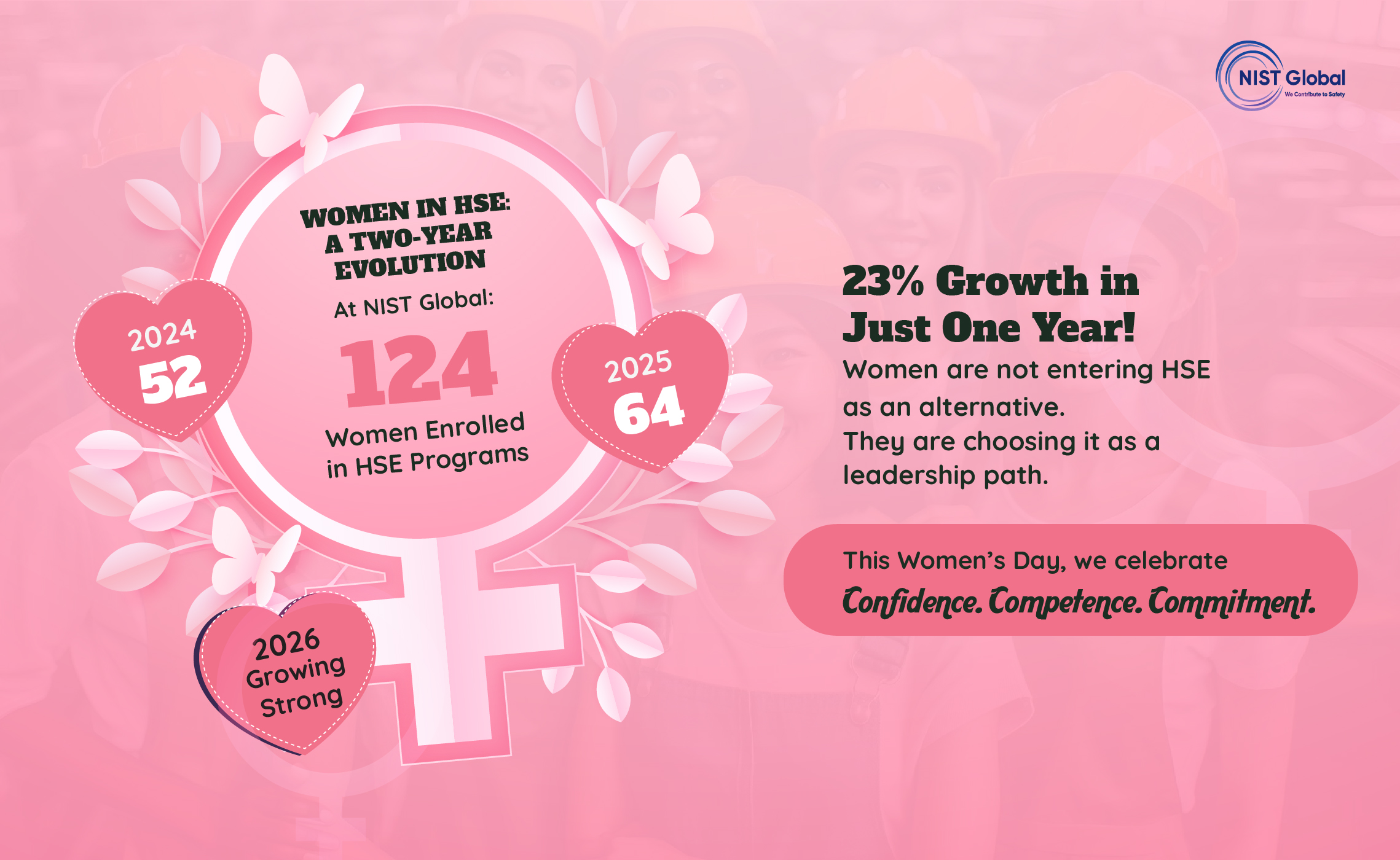
Between 2024 and early 2026, 124 women enrolled in HSE-related programs at NIST Global.
A closer look at the year-wise growth reveals something even more powerful:
- 2024: 52 women enrolled
- 2025: 64 women enrolled
- 2026 (ongoing): 8 women already enrolled
This reflects a 23% increase in female enrollments from 2024 to 2025 — a significant upward shift in just one year.
Behind every number there exists a professional who decides to work in a field that men used to dominate. Every enrollment represents a choice made by students who will lead their organisations while protecting their staff and creating safe work environments.
This is not an incremental change.
It is a directional change.
From Presence to Participation
The historical view of HSE roles established them as control functions that operated at construction sites and employed primarily male workers. The underrepresentation of women occurred because they lacked access and exposure to the field and because the industry held biased views about their abilities.
The underrepresentation of women occurred because they lacked access and exposure to the field and because the industry held biased views about their abilities.
Today, that perception is changing.
The women enrolling in HSE programs are not just fresh graduates exploring options. Many are:
- Transitioning from other industries
- Upskilling for leadership roles
- Entering core safety functions
- Preparing for international certifications
- Moving from administrative roles into strategic safety positions
The data from the last two years shows a clear pattern: women are not observing the industry from the sidelines — they are preparing to shape it.
Why This Shift Matters for HSE
HSE is no longer just about compliance and documentation. It is about:
- Behaviour-based safety
- Risk perception and communication
- Organisational culture
- Psychological safety
- Leadership influence
Research across industries has consistently shown that diverse teams make better risk decisions, communicate more effectively, and build stronger compliance cultures.
When more women enter HSE:
- Reporting improves
- Engagement increases
- Safety conversations become more inclusive
- Cultural transformation accelerates
The 23% growth between 2024 and 2025 is more than a statistic — it reflects a shift in how safety leadership is being built.
The Confidence Factor: A Visible Change
Over the past two years, a noticeable change has emerged among women professionals entering HSE:
Women are enrolling in advanced certifications, not limiting themselves to entry-level safety programs.
Many are not taking HSE as an alternative career path — they are choosing it deliberately.
More learners are aiming for supervisory and managerial roles rather than support functions.
Women from IT, healthcare, manufacturing, oil & gas support services, and construction are transitioning into structured safety careers.
This signals a deeper transformation:
HSE is being viewed not just as a technical requirement, but as a leadership discipline.
The Cultural Evolution in the Last Two Years
Between 2024 and 2026, three important shifts can be observed:
1.Normalisation of Women in Safety Roles
The question has shifted from “Can women work in HSE?” to “How quickly can we build competent safety leaders?”
2.Stronger Support Systems
Nowadays, there are more families and institutions that are urging women to achieve professional certification in security and compliance.
3.Career Longevity
More women are entering HSE as a long-term profession, not a temporary opportunity.
These changes indicate that the industry itself is evolving — and women are evolving with it.
Beyond Enrollment: Building Influence
Enrollment growth is only the beginning. The true impact lies in:
- Women taking up site-based safety roles
- Leading audits and inspections
- Managing compliance systems
- Conducting training sessions
- Contributing to behavioural safety programs
- Moving into the ESG and sustainability domains
HSE’s growth into environmental governance, sustainability reporting, and organisational culture development creates an opportunity for women professionals to shape its future direction.
The Bigger Picture
If 52 women enrolled in 2024 and 64 in 2025, what could the next two years look like?
If this growth trajectory continues, we are not just looking at increased representation — we are looking at:
- A stronger safety culture
- Balanced decision-making in high-risk industries
- Improved incident prevention
- More inclusive leadership structures
The transformation is gradual — but it is measurable.
What This Means for the Industry
For organisations, this growth presents an opportunity:
- Invest in inclusive hiring
- Create structured mentorship for women in safety
- Provide site exposure and leadership pathways
- Encourage certification-based growth
- Recognise safety leadership beyond gender
For aspiring professionals, the message is clear:
HSE is no longer limited by stereotypes.
It is driven by competence, commitment, and capability.
A Celebration with Direction
This Women’s Day, the focus is not just on appreciation — it is on progression.
124 women choosing HSE in just over two years is not a symbolic milestone. It is evidence of evolving ambition.
A 23% year-on-year increase is not just growth. It is momentum.
And momentum, when sustained, becomes transformation.
The future of HSE is not defined by who traditionally occupied the field.
It is defined by who is ready to lead it.
And over the past two years, more women have stepped forward — prepared, qualified, and determined to shape safer workplaces.
That is not just progress.
That is evolution.
Popular NEBOSH Courses
NEBOSH International General Certificate (IGC)
For beginners and supervisors wanting a strong foundation in health & safety.
NEBOSH International Diploma (IDip)
For experienced safety professionals aiming for senior HSE roles.
NEBOSH Process Safety Management (PSM)
For those in high-hazard industries focusing on process safety management.