
In many organisations, safety investigations begin with a single question: “Who is responsible?”
The danger of a blame culture emerges when organisations concentrate their efforts on assigning responsibility to specific individuals rather than using their resources to create a secure environment.
Employees who face the possibility of punishment embarrassment or disciplinary measures will not report near misses because they fear consequences and they will only handle errors through private fixes instead of exchanging knowledge with others. The process of eliminating risk creates a situation where dangers become concealed from view.
According to the International Labour Organisation (ILO), 2.78 million workers die each year from occupational accidents or work-related diseases — a stark reminder that documented safety systems alone are not enough to prevent harm.
A business can show compliance through its documentation but its employees will keep engaging in dangerous practices that remain hidden from view.
True safety transformation does not begin with blame. It begins with trust.
This blog delves into the importance of building trust in workplace safety and eliminating the blame culture within employees.
What Is a Blame Culture in Safety?
A blame culture exists when individuals are held solely responsible for incidents without examining systemic factors such as processes, supervision, communication gaps, or workload pressure.
It often sounds like:
-
“Why didn’t you follow the rule?”
-
“Who approved this?”
-
“This happened because someone was careless.”
Single employees do not create all safety failures because personal responsibility plays a role in safety failures but safety failures result from multiple factors. The majority of incidents take place because of:
-
Process breakdowns
-
Poor risk communication
-
Inadequate supervision
-
Production pressure
-
Gaps in reinforcement
When organisations focus only on the person and ignore the system, they miss opportunities for real improvement.
Hidden Costs of Blame Culture
Blame culture does more than damage morale — it weakens safety performance.
Under-Reporting of Incidents
Employees who fear consequences often avoid reporting near misses. According to the National Safety Council (NSC), up to 80% of workplace accidents are preceded by unreported near misses — lost opportunities for prevention.
Without transparent reporting, leadership loses visibility into real risks.
Loss of Trust
Trust is the foundation of any strong safety culture. When employees feel targeted rather than supported, psychological safety declines.
Instead of asking questions, workers stay silent.
Instead of learning together, teams operate defensively.
Repeated Incidents
If root causes are not addressed, the same mistakes recur. A disciplinary action may correct one individual’s behaviour temporarily, but it does not fix flawed systems.
Sustainable safety improvement requires systemic correction — not isolated punishment.
From Blame to Accountability
Breaking the blame culture does not mean eliminating accountability. It means redefining it.
Blame asks:
“Who caused this?”
Accountability asks:
“What allowed this to happen, and how do we prevent it?”
This shift changes everything.
In high-performing safety cultures:
-
Incidents are investigated for learning, not punishment
-
Leaders openly discuss mistakes
-
Reporting is encouraged and rewarded
-
Safe behaviours are reinforced consistently
This environment builds ownership rather than fear.
Role of Leadership in Building Trust
Leadership behaviour determines whether blame culture survives or disappears.
Employees observe:
-
How leaders respond to mistakes
-
Whether production pressure overrides safety
-
Whether open reporting is genuinely welcomed
If leaders react emotionally or inconsistently, trust erodes quickly.
However, when leaders:
-
Listen without immediate judgment
-
Focus on systemic improvement
-
Reinforce positive safety behaviours
-
Encourage proactive reporting
they cultivate a work environment where safety is genuinely valued.
According to research by Gallup, organisations with consistently engaged leadership show significantly higher safety performance and communication, correlating with better reporting and risk reduction.
Trust is built through consistent actions — not safety slogans.
Building a Speak-Up Safety Culture
To replace blame with trust, organisations must create structured mechanisms that support openness.
This includes:
-
Clear, fair investigation processes
-
Anonymous or protected reporting channels
-
Recognition for hazard identification
-
Coaching instead of immediate punishment
-
Leadership visibility in safety conversations
Most importantly, employees must believe that speaking up leads to improvement — not retaliation.
Cultural change does not happen by intention alone. It requires a systematic approach.
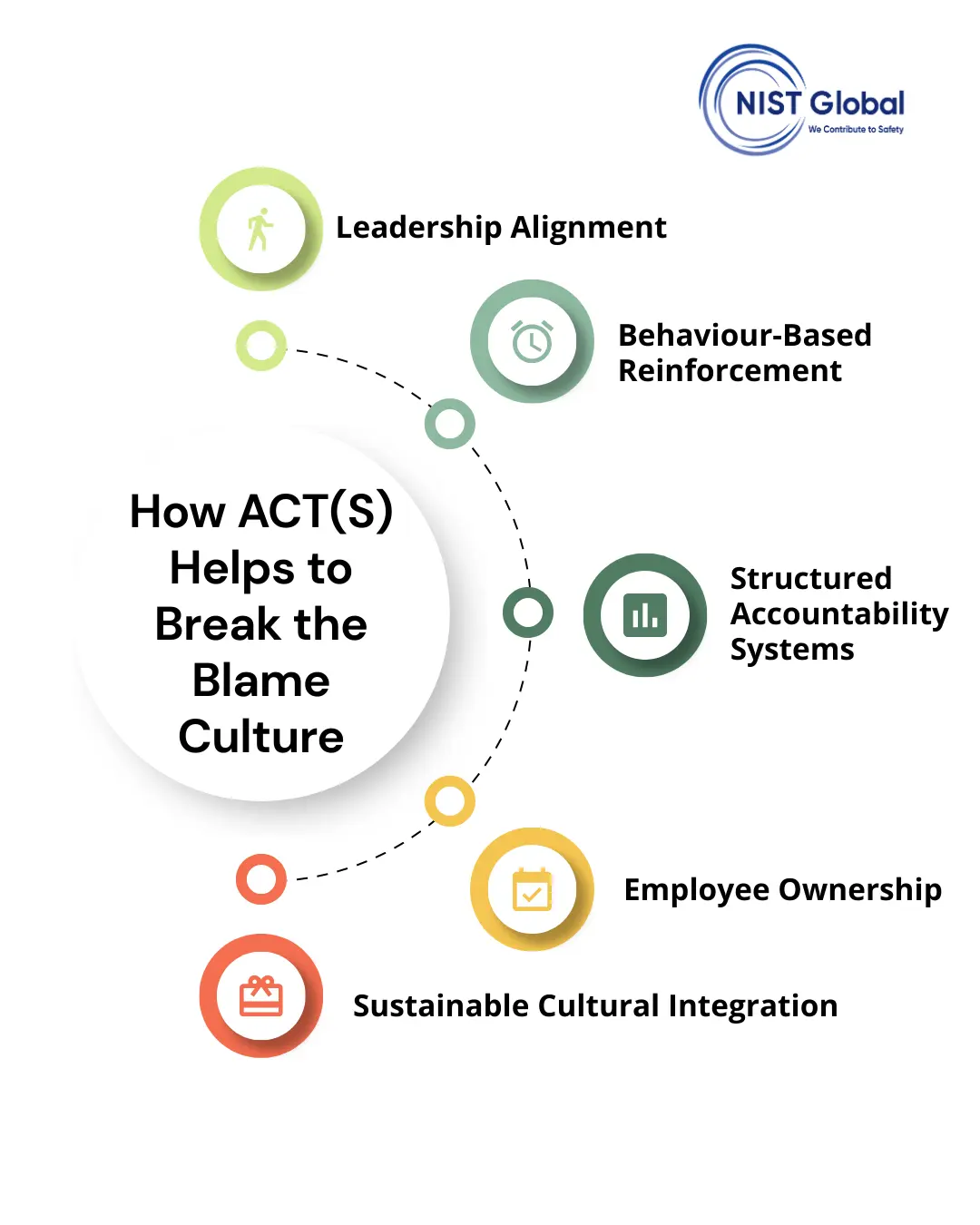
How ACT(S) Helps to Break the Blame Culture?
This is where Accelerated Culture Transformation (Safety) — ACT(S) plays a critical role.
Developed by NIST Global, ACT(S) is designed to address the behavioural and leadership gaps that allow blame culture to thrive.
Rather than focusing only on compliance, ACT(S) builds a structured framework that strengthens trust, accountability, and reinforcement.
1. Leadership Alignment
ACT(S) ensures leaders model consistent safety behaviour and respond constructively to incidents. This eliminates mixed signals that often fuel blame culture.
2. Behaviour-Based Reinforcement
Instead of reacting only to failures, ACT(S) emphasises reinforcing safe acts. Positive reinforcement shifts attention from punishment to prevention.
3. Structured Accountability Systems
ACT(S) balances fairness with responsibility. It distinguishes between human error, at-risk behaviour, and intentional violations — ensuring responses are appropriate and constructive.
4. Employee Ownership
By involving employees in safety observations and discussions, ACT(S) builds shared responsibility. When workers participate in solutions, engagement increases.
5. Sustainable Cultural Integration
ACT(S) integrates safety into leadership KPIs, operational decisions, and performance reviews — ensuring that trust-based safety is not temporary, but embedded into the organisation’s DNA.
Business Impact of Breaking Blame Culture
Organisations that replace blame with trust experience:
-
Increased hazard reporting
-
Faster identification of risks
-
Improved employee morale
-
Stronger operational reliability
-
Reduced incident frequency
More importantly, safety becomes proactive rather than reactive.
When employees feel safe to speak up, small risks are addressed before they become major failures.
Conclusion
Blame may create temporary compliance — but it destroys long-term trust.
Trust creates transparency.
Transparency enables learning.
Learning drives prevention.
If your organisation struggles with under-reporting, repeated incidents, or disengaged employees, the issue may not be policy — it may be culture.
Breaking the blame culture requires leadership courage, behavioural reinforcement, and a structured transformation framework.
Accelerated Culture Transformation (Safety) — ACT(S) by NIST Global provides that pathway.
When safety conversations shift from “Who is at fault?” to “How do we improve together?”, real transformation begins.
Moreover, that is how trust becomes your strongest safety system.